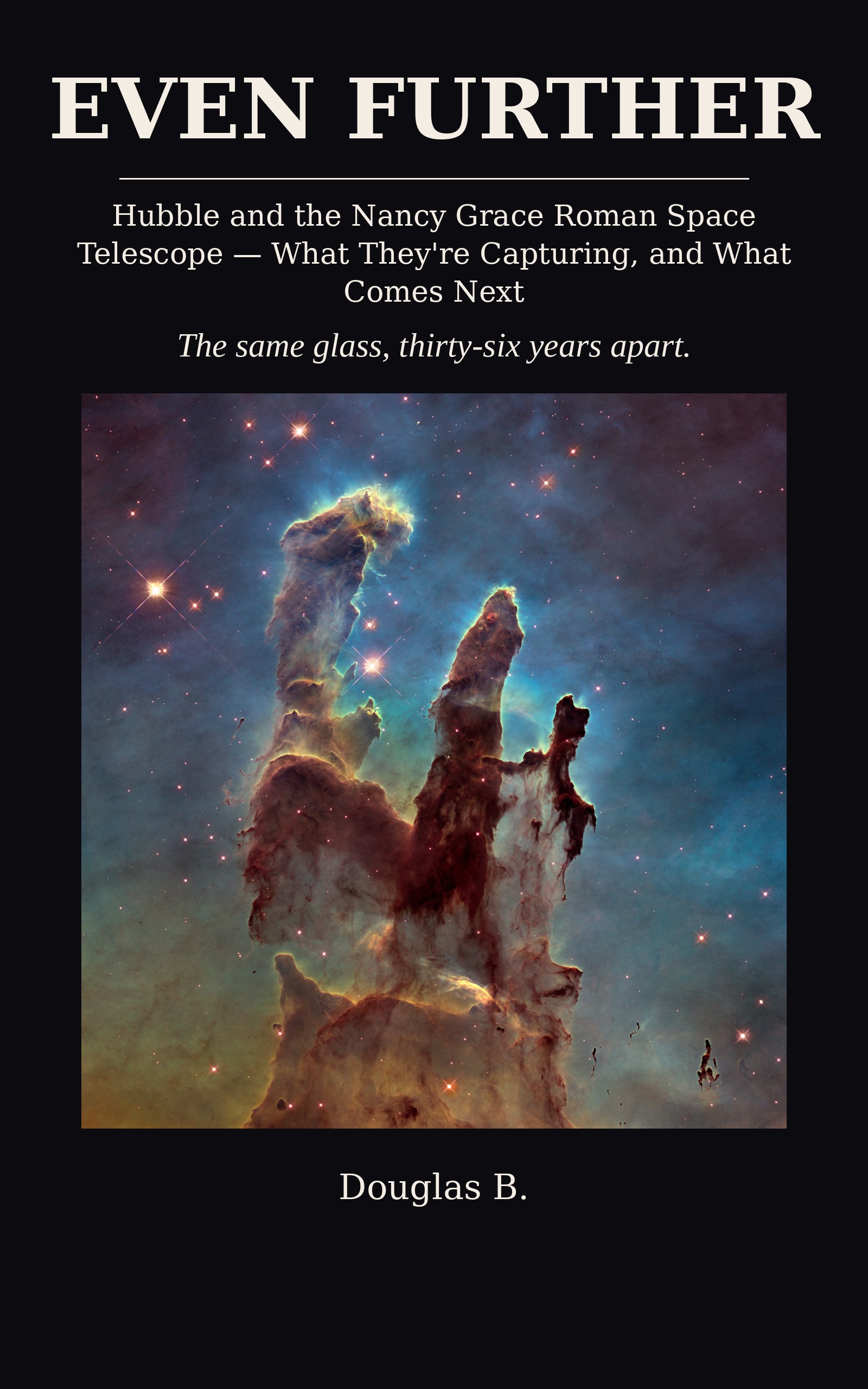
Even Further
The same glass, thirty-six years apart.
Hubble and the Nancy Grace Roman Space Telescope — What They're Capturing, and What Comes Next
Start reading
Read the introduction
This book is about two telescopes that share more than a mission. The Hubble Space Telescope and the Nancy Grace Roman Space Telescope were built, thirty-six years apart, around primary mirrors of exactly the same diameter: 2.4 metres. The same glass, in size at least — and almost nothing else about them is the same.
Hubble is the elder. It launched in April 1990, was designed for a fifteen-year mission, and is still working in its thirty-seventh year. It observes in ultraviolet, visible, and near-infrared light. It has been repaired and rebuilt by astronauts five times. Today it flies on a single gyroscope, circles the Earth about every 95 minutes at below 500 kilometres and falling, and remains so heavily requested that about six or seven proposals compete for every available slot. Its archive, as of 2026, holds more than 1.7 million observations and over 477 terabytes of data, and the papers written from it number more than 23,000.
Roman is the newcomer. It launched on 30 August 2026 and is, as this book goes to press, travelling to its station a million miles from Earth and being checked out instrument by instrument. Where Hubble looks closely at one small patch of sky at a time, Roman takes in a field of view at least 100 times larger with each exposure, at comparable sharpness — and its mirror, the same 2.4 metres across, weighs about 80 per cent less than Hubble's. Hubble finds and examines. Roman will census: whole populations of galaxies, stars, and planets, counted by the tens of millions. Neither telescope does the other's job. Roman has no ultraviolet capability at all, and ultraviolet is the light Hubble sees better than anything else flying.
Behind both of them stands one person. Nancy Grace Roman joined the young NASA, became its first chief of astronomy and the first woman to hold a leadership position there, and spent two decades building the institutional case for a great telescope in orbit — the campaign that produced Hubble. Her colleague Ed Weiler called her the Mother of Hubble. She died on Christmas Day 2018, aged 93. In May 2020, NASA named its next great observatory for her. She is the hinge of this book, and she gets a chapter of her own between its two halves.
A word about dates, because this book needs one. Everything in it is a snapshot as of November 2026. Hubble's totals move every month. Roman has not yet produced a single science image, and none will be presented here as one: its first are expected by early 2027, and what this book can show until then is launch photography, clean-room photography, and engineering test frames, each labelled for what it is. Hubble's ending is likewise undecided. Its orbit is decaying, its predicted re-entry window is 2033–34, and in October 2026 NASA formally asked industry whether a commercial mission could boost it, service it, or dispose of it safely — with responses due on 30 November 2026, inside this book's own production window. Where the record is open, the book leaves it open and says so.
What follows is in two parts. Part One is Hubble: the long argument that built it, the flaw that nearly ended it, the repairs that saved it, what it found, and the question now hanging over its last years. Part Two is Roman: the namesake, the gift of hardware that reshaped it, the wide eye it carries, its launch, and the census to come.
It is also a visual book, and the plates carry half the telling. Hubble's signature images appear throughout Part One with their full official credit lines printed beneath them — that credit is not a courtesy but the condition on which NASA, the Space Telescope Science Institute, and the European Space Agency make the images free to use. The deep fields are set in sequence, so the reader can watch one telescope stare at the same near-nothing for thirty years and count what accumulates. Roman's pictures, for now, are of a different kind: a rocket leaving Florida, an observatory in a clean room, a ring of deliberately unfocused stars from its first photons. The contrast is the honest state of things in November 2026 — one telescope with a third of a century of captures behind it, one whose first true capture is still months away.
Thirty-six years apart, two telescopes carry the same-sized mirror into the dark — and between them, they are still changing what the word "further" means.
Free editions
Free. No account, no email, nothing to sign up for.
Audio edition
The whole book, read aloud. 4 parts · 1 hour 52 minutes total.
Press play on any part — the book plays straight through to the end.
About the book
Two telescopes share more than a mission. The Hubble Space Telescope and the Nancy Grace Roman Space Telescope were built, thirty-six years apart, around primary mirrors of exactly the same diameter: 2.4 metres. The same glass, in size at least — and almost nothing else about them is the same. Hubble is the elder: launched in 1990, repaired and rebuilt by astronauts five times, and still working in its thirty-seventh year. Roman is the newcomer: launched on 30 August 2026, built around donated hardware reshaped for a new job, carrying a camera whose field of view is at least a hundred times Hubble's.
Part One — Seeing Further — tells Hubble's story: the long argument that put a great observatory above the atmosphere, the launch and the flaw found in its mirror, the repair that became the most celebrated service call in the history of spaceflight, and the five astronaut visits that rebuilt the telescope in orbit. It closes with what Hubble found — deep fields holding thousands of galaxies in a patch of sky that looked empty — and with the elder telescope's open ending, still working on a single gyroscope as a live conversation continues about servicing it one more time.
Part Two tells Roman's: the namesake, Nancy Grace Roman, the astronomer-administrator who campaigned the Large Space Telescope into existence; the gift of telescope hardware that gave her namesake telescope its mirror; the wide eye it carries; its launch on 30 August 2026 and the first-photons test frame that followed; and the census to come, when its first science images arrive by early 2027. A short closing sets the two mirrors side by side.
The book is a snapshot, and it says so: facts are stated as of November 2026, with sources drawn from the agencies' and institutes' own pages and papers. Roman had taken no science images when this edition closed; the book plates its first engineering frame as what it is, and labels its simulations as simulations.
Inside the book
- Part One — Seeing FurtherThe Long Argument · Launch, and the Flaw · The Repair · Five Visits · What Hubble Found · The Elder · The Open Ending
- Part TwoThe Namesake · The Gift · The Wide Eye · Launch, and First Photons · The Census to Come
- ClosingThe Mirror, Twice
- Back MatterThe Snapshot Statement · Sources · Plate Credits
The plates
The plates are the telescopes' own: Hubble's archive photography, from the 1995 original of the Pillars of Creation to the Legacy Field's sixteen years of accumulated sky, and Roman's own record — the observatory in the Goddard clean room, its camera's focal plane, its launch, and its first-photons engineering frame, a sea of out-of-focus stars that is exactly what it is captioned to be. Simulations are captioned as simulations. Every plate is credited to the archive it came from, in the book's Plate Credits.
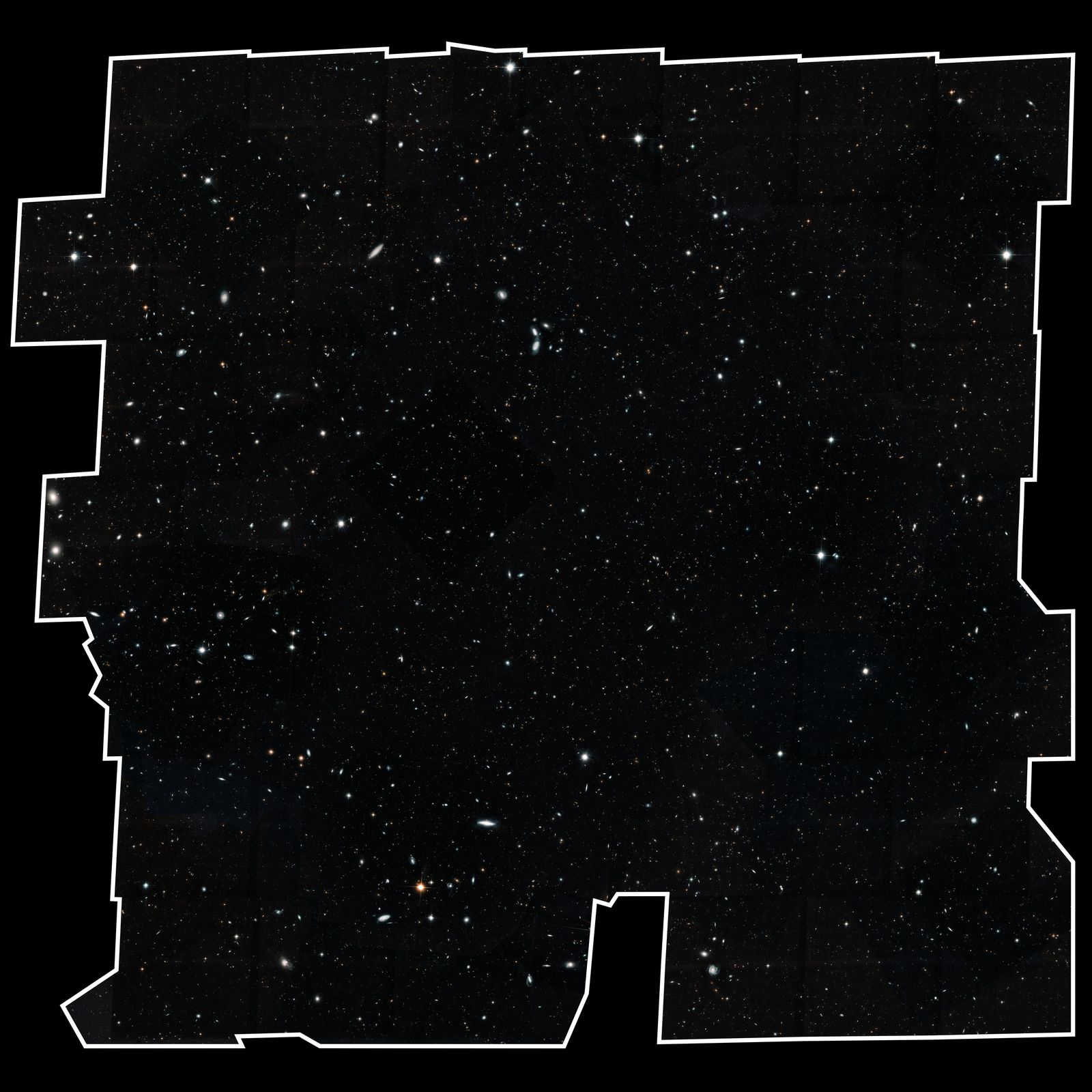
The Hubble Legacy Field — some 265,000 galaxies in one assembled view. Credit: NASA, ESA, and G. Illingworth (University of California, Santa Cruz; UCO/Lick Observatory)
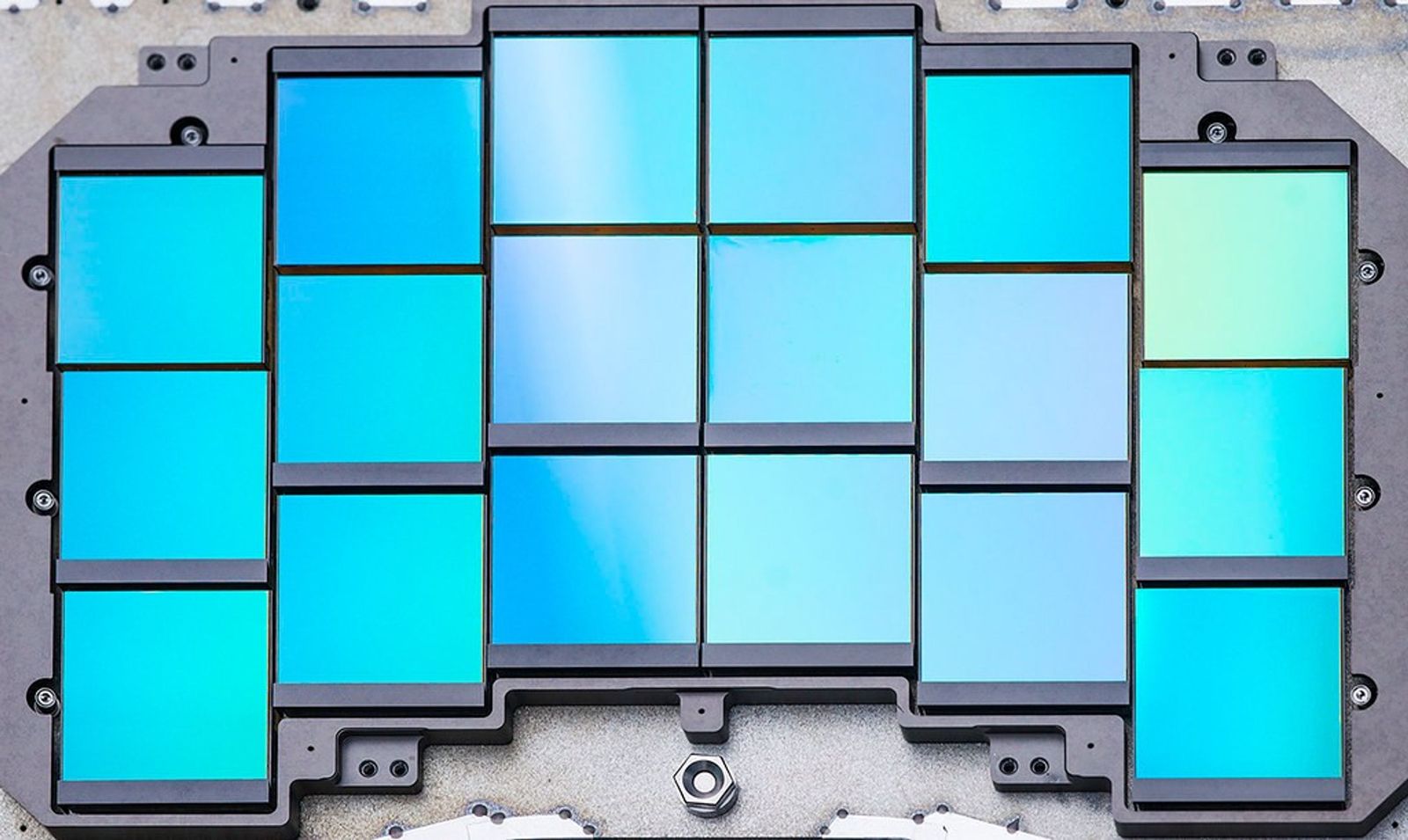
Roman's Wide Field Instrument focal plane — eighteen detectors, 300 megapixels. Credit: NASA/Chris Gunn
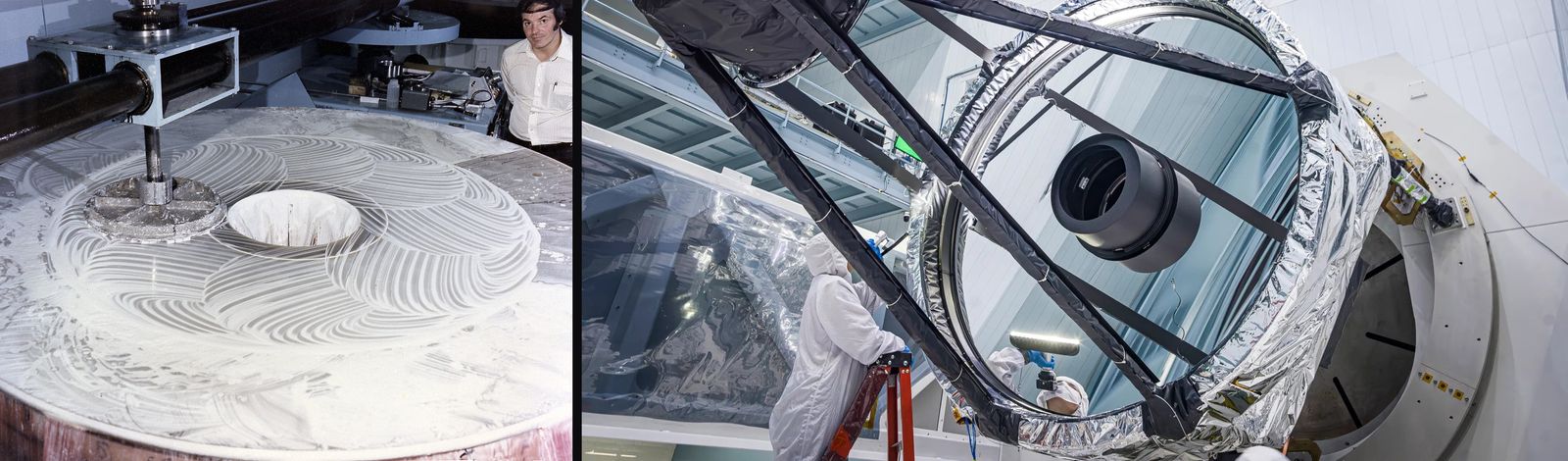
The two mirrors, one diameter: Hubble's primary at Perkin-Elmer, and Roman's under inspection at Goddard. Credit: NASA (Hubble mirror, left); NASA/Chris Gunn (Roman mirror, right)
Two plates from the research shelf were left out, openly: the great Carina panorama and the Helix Nebula view both blend Hubble data with ground-based photography from other telescopes, and their rights could not be cleared as cleanly as the rest. The book's About the Plates says the same.
About the author
The author’s page — the painter, the builder, and the other books — lives on the home page.