Closing — The Mirror, Twice
— The Mirror, Twice
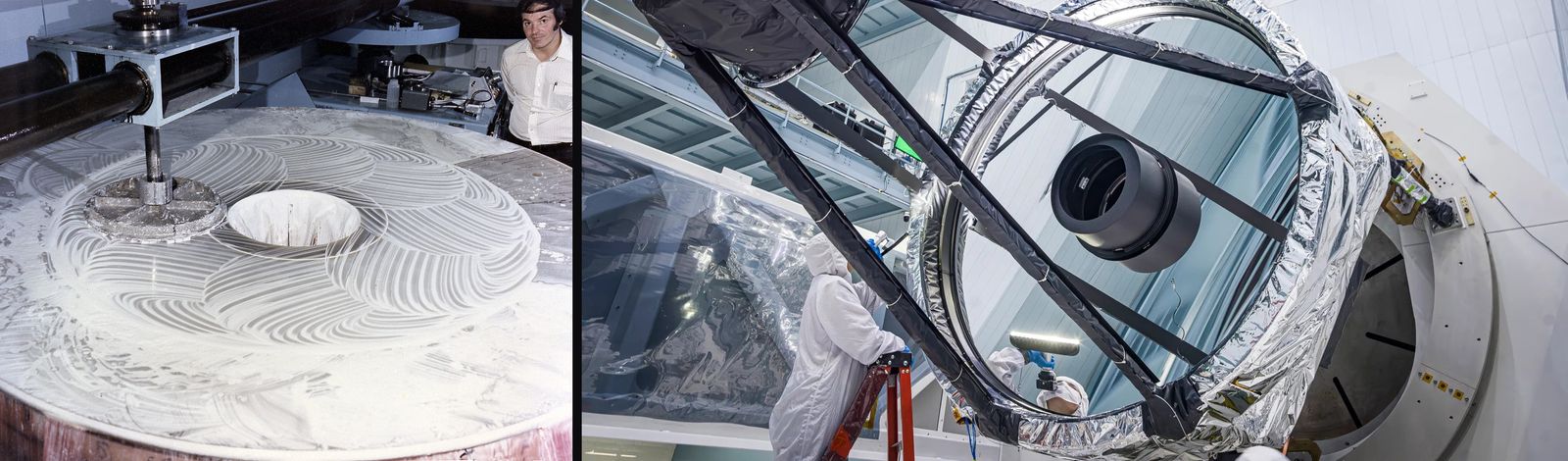
Two mirrors, one diameter. Hubble's 2.4-metre primary was the product of a 1970s budget compromise; Roman's 2.4-metre primary was inherited hardware, donated and refigured. At roughly a fifth of the elder mirror's weight, and feeding a camera with a field at least one hundred times wider, the younger mirror is the measure of what forty years changed — and what it did not. A woman who never flew argued the first of these telescopes into existence and lent her name to the second. The same glass, worked twice, thirty-six years apart, is still pointed outward — one eye near home and failing gracefully, one eye a million miles out and just opening. Between them they have not finished. Judging by every deeper field either has ever taken, neither has the sky. No end in sight.
Credit: NASA (Hubble mirror, left); NASA/Chris Gunn (Roman mirror, right)
Everything in this book reduces, in the end, to a single measurement repeated twice: 2.4 metres.
The first time, the number was a compromise. The Large Space Telescope was drawn at three metres and cut down under budget pressure in the 1970s, and the mirror that resulted — ground in Danbury, polished superbly to a figure wrong by about two micrometres — launched in 1990, was corrected by astronauts in 1993, and has been working since. The second time, the number was an inheritance. A reconnaissance programme built telescope assemblies around 2.4-metre mirrors, found it did not need them, and gave the hardware to NASA; one of those mirrors, refigured and lightened by forty years of progress to about a fifth of the elder mirror's weight, launched in 2026.
Same diameter. Nearly everything else inverted. Hubble looks at small pieces of sky with unmatched sharpness, in ultraviolet, visible, and near-infrared light. Roman takes in a field at least one hundred times larger at comparable sharpness, in visible and near-infrared light, and surveys where Hubble samples. Hubble's data filled a great public archive across thirty-six years; Roman returns more data in a day than many observatories manage in a year, and gives it away immediately. Hubble was serviced by hand, five times, by astronauts. Roman is beyond any hand's reach at L2 and must simply work.
Longevity tells the same double story. Hubble was designed for a fifteen-year mission; it is past thirty-six years, kept alive first by astronaut servicing and then by ground-side ingenuity, rationing gyroscopes and accepting narrower skies to buy time. Roman is designed for five years with a built path to ten, carries fuel that could in principle last far longer, and will never be touched again by human hands — whatever it becomes in its second decade, it becomes on its own. The elder telescope's life was extended by repair. The younger one's can only be extended by margin: by everything its builders put in reserve before it left. Both are, in their different ways, arguments that a telescope's working life is decided less by its launch day than by the care taken before and after it.
And the division of labour between them is not a handover but a partnership with one clear asymmetry. Roman has no ultraviolet capability, and neither does Webb. The hottest and most violent light in the universe — young massive stars, gas falling toward black holes, the thin medium between galaxies — is still Hubble's alone to record, and no successor with comparable ultraviolet capability is expected before the proposed observatories of the 2040s. The elder telescope is not keeping a seat warm. It is holding a wavelength range that closes when it closes.
Even the names make the pairing. One telescope is named for an astronomer — the man whose observations established that the universe expands. The other is named for an administrator — the woman who established that the first telescope would exist. Science remembers its discoverers by reflex and its institution-builders by effort. That both kinds of name now ride on the same size of glass, pointed at the same sky, is the closest thing this subject has to a complete sentence about how astronomy actually gets done: someone finds, and someone makes the finding possible, and the mirror does not care which name it carries.
The book therefore ends, as it was written, with two open endings. One belongs to Hubble: falling slowly from below five hundred kilometres, its predicted re-entry in 2033–34, and a formal question now in front of the commercial space industry — boost it, service it, or dispose of it — with responses due on 30 November 2026 and any rescue required to fly by 2032. The other belongs to Roman: commissioning under way, an orbit insertion expected in early December 2026, and first science images expected by early 2027, when the census begins and this book's second half turns from capability into record. Both endings will have moved by the time many readers reach this page. That is stated in the snapshot statement, and it is the honest condition of a book about instruments that are still working.