Part Two
Chapter 8 — The Namesake
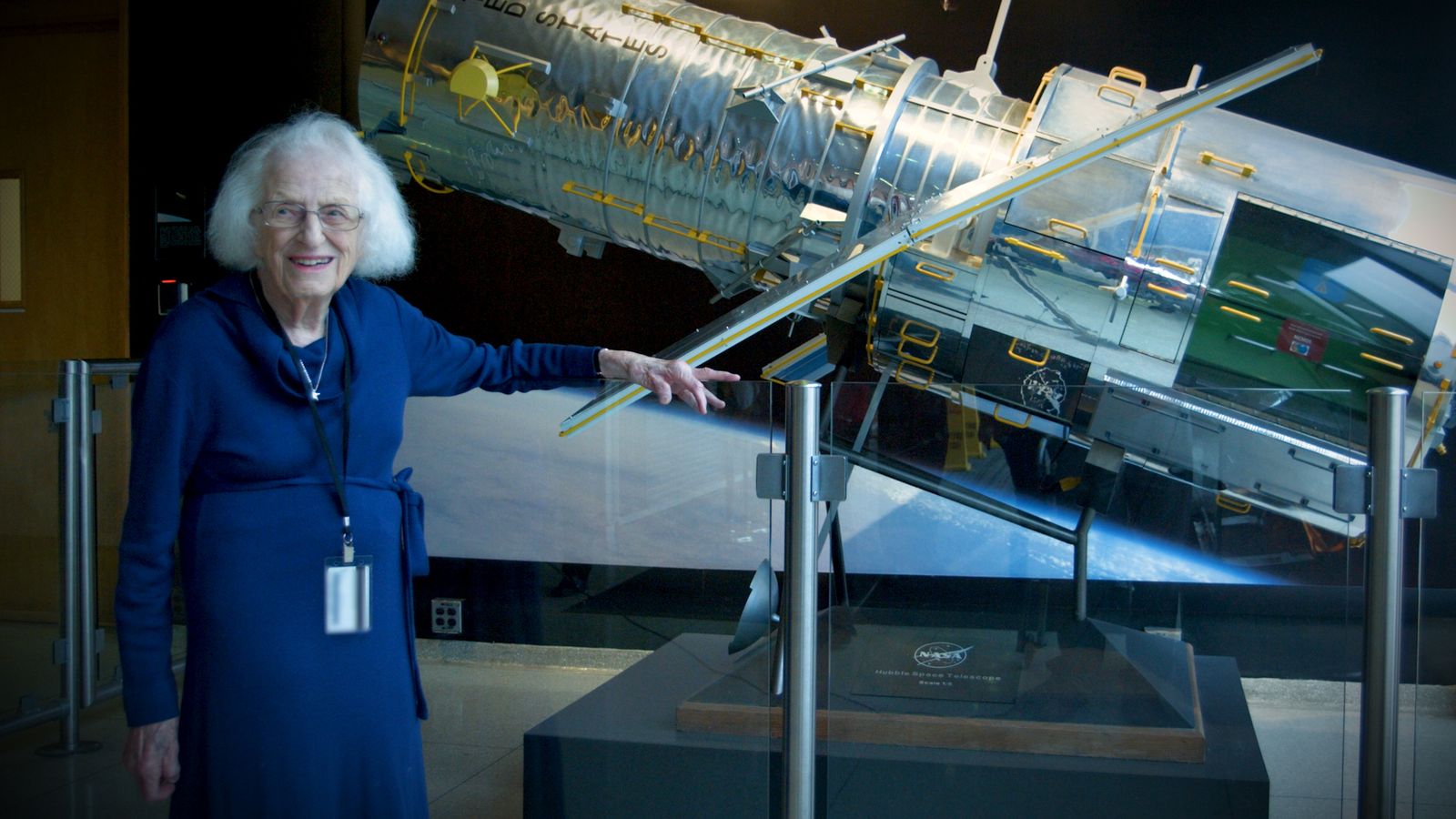
Nancy Grace Roman joined NASA in 1959, six months after the agency was founded, and became its first Chief of Astronomy. For two decades she led the committees, the planning, and the congressional case for a large space telescope. The telescope that case produced was Hubble. The telescope that carries her name launched in 2026. She is the hinge between the two halves of this book.
Credit: NASA
Part One of this book belongs to a telescope. Part Two belongs to another one. This chapter belongs to the person who stands in both.
Nancy Grace Roman was born on 16 May 1925. She took her degree at Swarthmore College in 1946 and her doctorate in astronomy at the University of Chicago in 1949, and in 1959 — six months after the agency itself was founded — she joined NASA. By 1960 she was in post as Chief of Astronomy and Relativity: NASA's first Chief of Astronomy, and its first woman in a leadership position, the first female executive in the agency's history.
The job she took on was not, at the start, a telescope. It was an argument. Astronomers had been making the case for an observatory above the atmosphere since Lyman Spitzer's paper of 1946, and inside the young agency someone had to convert that case into committees, plans, budgets, and testimony. For the next two decades, that someone was Roman. NASA's own biography describes the work plainly: she led science and planning committees, brought together scientists and engineers, briefed executive branch officials, and lobbied NASA officials for what was then called the Large Space Telescope. When NASA representatives appeared before Congress on the subject, she wrote the testimony. The pitch she used has come down as a quip rather than a transcript, and it deserves to be quoted as she meant it — as a way of making a national instrument sound affordable: for the price of one night at the movies each year, each American would receive fifteen years of exciting discoveries.
Arguments like that are usually remembered as rhetoric. Roman's had engineering consequences. One of them is easy to miss and worth recording: she pushed to get charge-coupled devices — CCDs — installed as the telescope's image sensors, instead of the sensor technology that had been standard before them. The electronic eye that made Hubble's images possible, the eye whose descendants sit in nearly every camera flown since, is there partly because the chief of astronomy insisted on it during the years when the design was still fluid. Institutions remember launch dates. They less often remember who chose the detector.
The machinery she ran can be seen in the programme's paper trail. A National Academy of Sciences report in 1969 endorsed the scientific case for a large space telescope. A first working-group meeting in 1974 settled into concepts, budgets, and technical requirements, with the science side recommending interchangeable instruments working across ultraviolet, visible, and infrared light. In 1975 the European Space Agency joined the project, providing fifteen percent of the funding through an instrument and the solar arrays, in exchange for a guaranteed share of observing time for European astronomers. None of these steps is a discovery. All of them are the substance of institution-building: the slow conversion of a good idea into an international programme with a budget line. That conversion was Roman's daily work for the better part of twenty years, conducted in committee rooms and hearing rooms rather than at a telescope.
Her title deserves a moment of precision, because it is easy to read past. A chief of astronomy at a new agency does not merely advise. The role sat at the junction where scientific priorities became agency plans — where the community's wishes were weighed, sequenced, and defended in front of the officials who controlled the money. To hold that post as the first woman in a leadership position at NASA, in the 1960s, while carrying a programme whose payoff lay decades in the future, required a particular kind of stamina: the willingness to keep making the same correct argument, in improving forms, until the institution was ready to fund it. The pitch about the price of a night at the movies was the public surface of that stamina. Underneath it sat twenty years of committee work that almost nobody outside the agency ever saw.
The campaign took roughly two decades, which is the correct timescale for what she was doing. She was not proposing an instrument; she was building the constituency, the committee record, and the congressional patience that a flagship observatory requires before a single piece of glass is ground. Congress approved funding in 1977. The telescope that resulted was renamed for Edwin Hubble in 1983 and launched in 1990, and it became, after its repair, the most productive observatory of its era. Her colleague Ed Weiler gave her the title the history books kept: the Mother of Hubble.
Roman did not live to see her name go to space. She died on 25 December 2018, aged ninety-three — after Hubble's twenty-eighth year in orbit, and while the agency's next wide-field flagship still existed under its working name, WFIRST, the Wide Field Infrared Survey Telescope.
On 20 May 2020, NASA renamed that mission. Administrator Jim Bridenstine announced that WFIRST would be called the Nancy Grace Roman Space Telescope, and his reason was stated in terms of succession: it was because of Nancy Grace Roman's leadership and vision that NASA became a pioneer in astrophysics and launched Hubble, and he could think of no better name for the successor to NASA's Hubble and Webb telescopes.
Consider what the naming actually joins. The woman spent twenty years arguing one telescope into existence — a 2.4-metre mirror pointed at small patches of sky with unmatched sharpness. The telescope that carries her name is built around a mirror of exactly the same diameter, 2.4 metres, pointed at patches of sky at least a hundred times wider. She campaigned for the first. She never saw the second fly; it launched on 30 August 2026, nearly eight years after her death. The two halves of this book are not joined by a theme imposed afterwards. They are joined by a career.
That is why she gets a chapter of her own, placed here, between the elder telescope and the younger one. Everything in Part One happened because the argument she ran for two decades was won. Everything in Part Two happens under her name. The rest of this book is about what the second telescope is, where its mirror came from, and what it is doing right now, a million miles from Earth, with its instruments waking up.
The timing of the naming is part of its meaning. It came in May 2020, two months after NASA approved the mission for implementation — after the design gates, when the telescope had stopped being a study and become a build. Names given at that stage are not aspirations; they are identities the hardware carries through integration, testing, and launch. Roman's name accordingly appears in the record of every milestone that followed: the completed mirror in 2020, the passed design review in 2021, the finished observatory in 2025, and the launch coverage of 30 August 2026, when the agency that she joined in its first year sent her name a million miles from Earth. She had been gone nearly eight years. The argument she spent twenty years winning is, at the time of this book, still producing new chapters.
Chapter 9 — The Gift
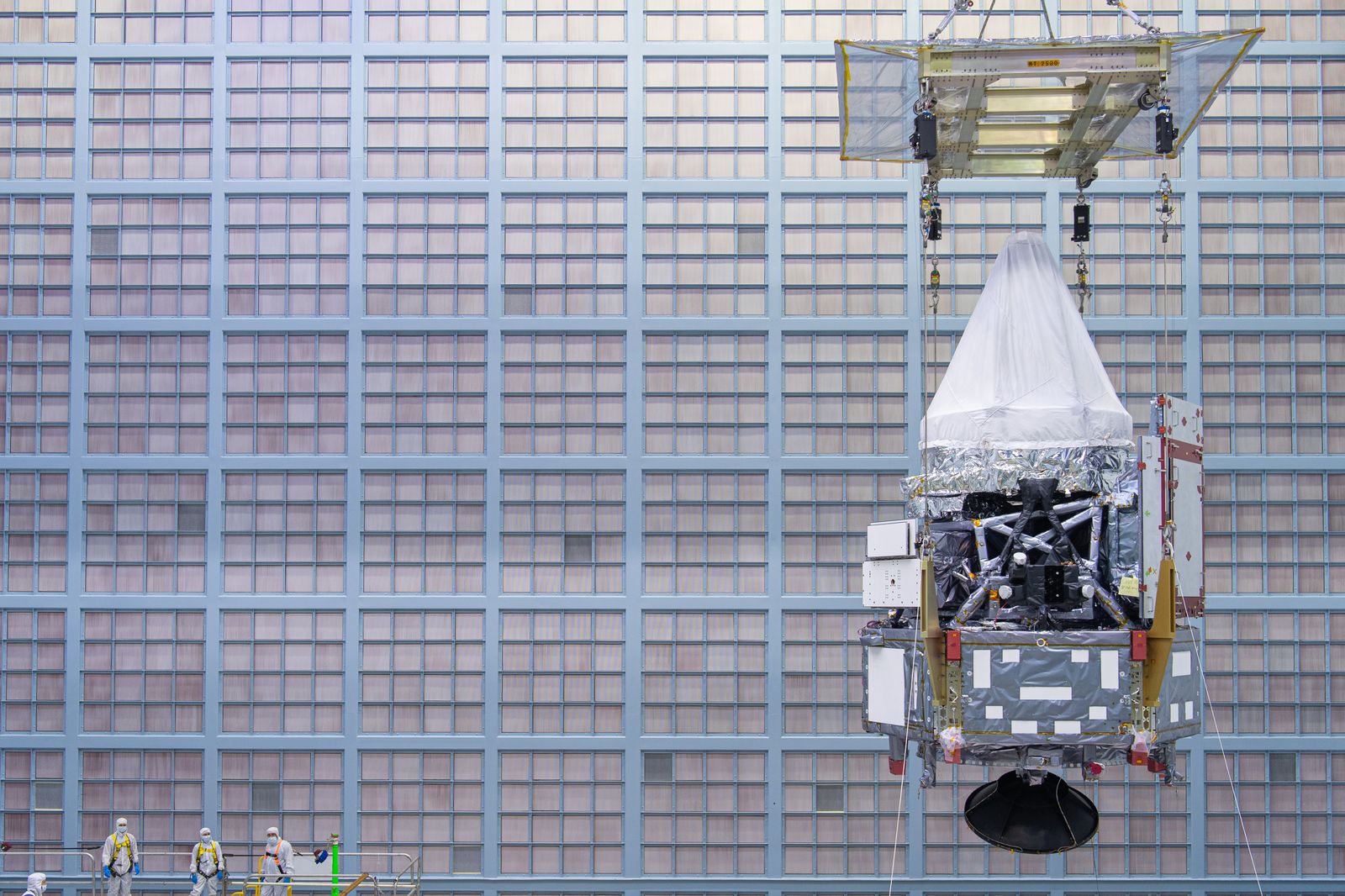
The Roman observatory's primary mirror is 2.4 metres across, the same diameter as Hubble's. It began as part of a telescope assembly built for the National Reconnaissance Office and donated to NASA, then was refigured for astronomy at L3Harris in Rochester, New York. The donation was hardware — optics, structures, controllers, and a baffle — not a finished telescope. NASA built the observatory around it.
Credit: NASA/Goddard Space Flight Center/Michael Guinto
Every flagship observatory begins as a line in a survey. Roman began as two.
In 2010, the National Academies' decadal survey New Worlds, New Horizons — the astronomy community's once-a-decade ranking of what to build next — named the Wide Field Infrared Survey Telescope, WFIRST, its top-ranked priority for a large space mission. As ranked, WFIRST was a comparatively modest instrument: a near-infrared observatory built around a mirror of roughly 1.3 to 1.5 metres, designed to survey wide areas of sky in infrared light. It was a plan in search of hardware.
The hardware arrived from an unexpected direction. In January 2011, the National Reconnaissance Office — the agency that builds and operates the United States' reconnaissance satellites — told NASA it had two unneeded telescope optical systems. NASA accepted the offer in August 2011. On 4 June 2012, the donation was announced publicly: NASA had taken ownership of hardware for two telescope assemblies, stored at their manufacturer, ITT Exelis in Rochester, New York, each built around a primary mirror 2.4 metres across — the same diameter as Hubble's.
Precision matters here, because the gift is often described more grandly than it was. NASA did not receive two finished telescopes. What changed hands, as NASA Astrophysics Director Paul Hertz described it in July 2012, was space-qualified optics, support structures, controllers, and a baffle for two systems, plus extra parts. There were no instruments. There was no spacecraft, no electronics suite, no launch. What NASA received was the hardest and most expensive single component of a space telescope — its figured optics, already made — and the obligation to build everything else around them.
One assembly was enough. On 30 May 2013, the NASA Administrator directed that pre-formulation work on WFIRST continue using the donated assets — the programme known as WFIRST-AFTA, the Astrophysics Focused Telescope Assets study — basing the design on one of the two donated assemblies. The decadal survey's modest infrared surveyor was redesigned around a mirror nearly twice the diameter originally planned, at no cost for the glass itself. That single substitution is the reason the younger telescope in this book has the same-size eye as the elder: not imitation, and not coincidence, but inheritance.
A design needs instruments, and in 2014 the pair was set: the Wide Field Instrument, a wide-field near-infrared camera, and the Coronagraph, an instrument for suppressing a star's light to image the planets around it. Those two — one to survey, one to demonstrate a new way of seeing — remained the payload from that point forward, through every review the mission subsequently passed.
Formalities followed. On 17 February 2016, NASA's Associate Administrator approved WFIRST to begin Phase A — the mission's formal new start. The following day, 18 February 2016, NASA announced that WFIRST had formally transitioned from a study to a project, with an orbit around the Sun–Earth L2 point selected the same month. The dates differ by a day because they record two different steps: the internal approval, then the public announcement.
It is worth pausing on what the donation did to the mission's economics and its politics. The decadal survey had ranked WFIRST first among large missions on the strength of a smaller telescope. A sceptical reader of budgets could ask whether a bigger mirror meant a bigger bill and a longer road. The gift answered part of that question in advance: the single most difficult component — a space-qualified 2.4-metre primary and its assembly hardware — already existed, built and paid for under another programme. What remained was everything else, and everything else was substantial: a spacecraft, two instruments, a decade of integration and testing, a launch vehicle, and five years of operations. The mission's later cost history belongs to that remainder. When NASA approved WFIRST for implementation on 2 March 2020, the expected development cost was 3.2 billion dollars, with a maximum total cost of 3.934 billion including the Coronagraph and five years of science operations; a replan in June 2021 set the life-cycle cost at 4.316 billion dollars. Those are the honest numbers, and the chapters ahead keep them in view: the glass was a gift, the observatory was not free.
Design maturity had its own gate. On 29 September 2021 the mission passed its Critical Design Review, NASA's formal finding that the design and developmental engineering work was complete and the project could proceed to build in earnest. The build that followed — focal plane, instrument, telescope assembly, payload, spacecraft — is the subject of the next two chapters, and nearly every dated milestone in them descends from the sequence set in motion here: a 2010 ranking, a 2011 offer, a 2012 announcement, a 2013 direction to use the assets, a 2014 instrument pair, and a formal start in February 2016.
The remaining gates can be told briefly, because the chapters after this one take them up in the hardware. NASA approved the mission for implementation on 2 March 2020. On 20 May 2020 it received its permanent name, for the woman in the previous chapter. The life-cycle cost, after a June 2021 replan, stood at 4.316 billion dollars — the figure launch coverage rounds to $4.3 billion. The mirror at the centre of it all, the donated glass, was refigured and modified for its new purpose at L3Harris in Rochester, New York, and completed on 3 September 2020.
Step back and the shape of the thing is unusual. A survey committee asked for a telescope. A spy-satellite agency handed over optics built for another purpose entirely. The mission that resulted carries the name of the administrator who campaigned Hubble into existence, and it flies a mirror the same size as Hubble's because that is the size the donated hardware happened to be. Almost nothing about Roman's origin was planned as a whole. What NASA did, methodically and over fifteen years, was build a coherent observatory out of the parts it had been given — and then fly it ahead of schedule and on budget. The next chapter looks at the machine they built.
One geographical detail ties the gift together. The assemblies were stored at their manufacturer in Rochester, New York. Decades later, the refiguring of the chosen primary — the work that converted reconnaissance optics into an astronomy mirror finished to Roman's requirements — was also done in Rochester, at L3Harris, and completed on 3 September 2020. Rochester has been an optics city for generations, home to the firms that ground and polished much of America's space glass, reconnaissance and civilian alike. The donated mirror never really left home. It waited in the city that made it, was remade in the city that made it, and left for Maryland and then Florida as the heart of a telescope its builders had never intended it for. The gift, in the end, was not only hardware. It was hardware plus the industrial base that knew what to do with it.
Chapter 10 — The Wide Eye
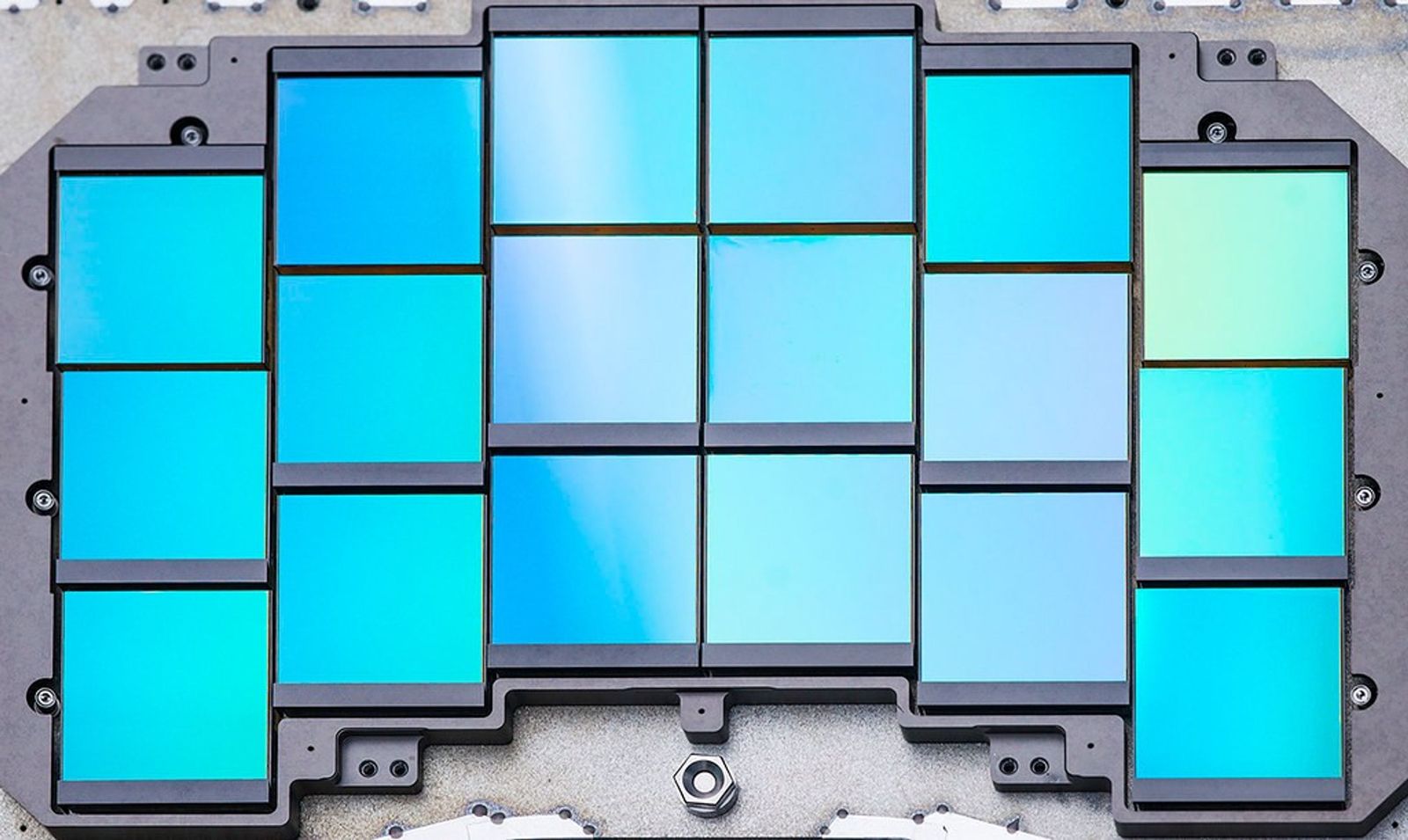
Roman's Wide Field Instrument is a 300-megapixel camera: eighteen detectors behind a 2.4-metre mirror, covering 0.281 square degrees of sky in one exposure — a field bigger than the full Moon, at least one hundred times wider than Hubble's view, in light from the visible to the near-infrared.
Credit: NASA/Chris Gunn
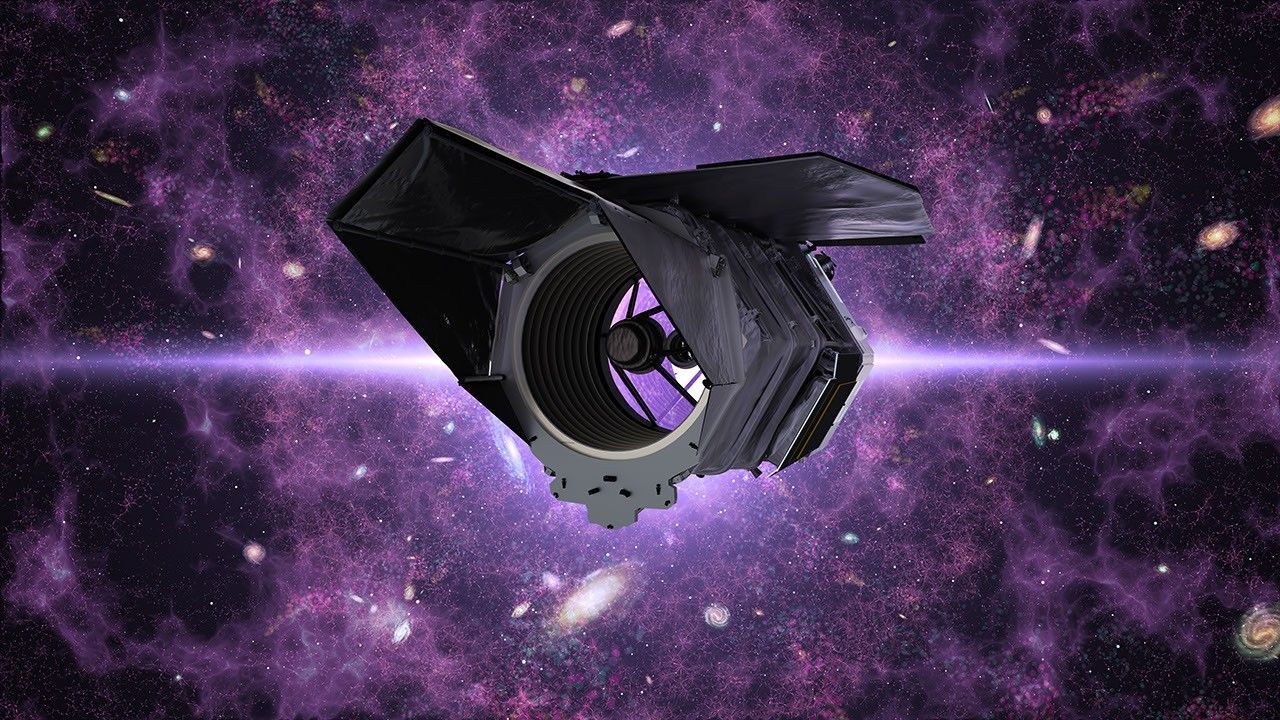
The artist concept shows the Roman observatory as it is designed to appear at the Sun–Earth L2 point, about a million miles from Earth. It is a simulation, drawn before launch — not a capture from the spacecraft.
Credit: NASA's Goddard Space Flight Center
Start with the mirror, because the mirror is the book's refrain. Roman's primary is 2.4 metres in diameter, exactly Hubble's diameter. The resemblance ends at the rim. Hubble's primary weighs 828 kilograms. Roman's weighs about 410 pounds — roughly 186 kilograms, about eighty percent less, less than a quarter of Hubble's weight for the same collecting area. Between those two numbers sits forty years of optics: the younger mirror was received from another government agency and modified for astronomy, its refiguring completed at L3Harris in Rochester, New York on 3 September 2020. It is one of ten mirrors in the telescope; on 17 April 2024 the full set was combined and the telescope passed its first vision test.
Behind the mirror sits the reason the mirror matters: the Wide Field Instrument, the WFI. NASA describes it publicly as a 300-megapixel camera, and 300 megapixels is the figure this book uses. The array behind the number is eighteen detectors, each a grid of 4,096 by 4,096 pixels, working together as one focal plane. In a single exposure the WFI covers 0.281 square degrees of sky — a patch bigger than the full Moon appears from Earth — across wavelengths from 0.48 to 2.3 micrometres, from visible light into the near-infrared. Eight imaging filters span that range, and the instrument also works as a slitless spectrometer, spreading the light of everything in the field into spectra. Its pixels sample the sky at 0.11 arcseconds each. Set against Hubble, whose sharpness Roman matches, the field of view is the revolution: at least one hundred times larger in a single frame.
An instrument like that is built, deliberately, over years. The focal plane system — the camera's heart — was completed and delivered on 16 May 2023. The Wide Field Instrument itself was completed on 13 September 2023. In May 2024 the second instrument arrived, and on 12 December 2024 telescope and instruments were integrated together onto the instrument carrier: the payload was complete.
The focal plane itself rewards a closer look. Each of the eighteen detectors holds about 16.8 million pixels; the flight array flies with six spares built alongside it. The detectors do their work cold — an operating temperature near 89.5 kelvin, colder than −180 degrees Celsius — because infrared sensors must be quieter than the faint heat of the sky they measure. The instrument's eight imaging filters divide the 0.48-to-2.3-micrometre range into bands, letting astronomers select the colour of infrared light a survey requires, and a grism and prism turn the same focal plane into a slitless spectrometer: instead of a spectrum of one chosen object, every object in the wide field gets its light spread at once. That is the wide eye's real character. It does not merely photograph more sky per frame; it measures more of what is in the frame — positions, colours, spectra, and, across repeated visits, changes — for everything that falls inside its Moon-sized view.
The second instrument is the Coronagraph, built by the Jet Propulsion Laboratory and delivered to Goddard in May 2024, then integrated onto the instrument carrier that October. Its task is the hardest trick in observational astronomy: block a star's light so completely that the planets beside it — planets as much as one hundred million times fainter than their star — become visible directly. It does this with masks, deformable mirrors, and control loops that hold the darkness steady. One thing must be said about it exactly as NASA says it: the Coronagraph is a technology demonstration. It is not a survey instrument and it is not expected to work like one. Over roughly three months of preplanned observations spread across the mission's first eighteen months, it is meant to prove techniques that a future observatory — one built to photograph Earth-like planets — will depend on. Judged as a demonstration, even a partial success is a result.
The last component of the wide eye is the one readers never see: the data system. Roman is expected to return about 1.4 terabytes of data a day — some 20,000 terabytes over its five-year prime mission — downlinked at up to 500 megabits per second through ground stations in New Mexico, Australia, and Japan, and delivered into the Mikulski Archive for Space Telescopes, the same public archive that holds Hubble's data. There is no proprietary period. Roman's observations are public from the start, available to any astronomer — and any member of the public — on the same terms.
The scale of that archive deserves one comparison. Hubble's entire public archive, accumulated over thirty-six years, passed 477 terabytes in 2026. Roman, at about 1.4 terabytes a day, returns more than 500 terabytes a year — which is to say, it will exceed the elder telescope's lifetime archive roughly every year it operates, and reach some twenty petabytes across the five-year prime mission. This is not a criticism of the elder instrument; it is the arithmetic of the wide eye. A camera that photographs a Moon-sized field at Hubble sharpness, night after night for years, cannot help producing a flood. The mission was designed around the flood: downlink rates up to 500 megabits per second, the highest of any NASA astrophysics mission, and an archive built to serve the data to the world rather than to a fortunate few.
The telescope assembly around the instruments completes the picture. The Optical Telescope Assembly — the primary, nine additional mirrors, and their structures and electronics — was delivered to Goddard's largest clean room on 7 November 2024, the final major delivery of the build. A telescope, in other words, of ten mirrors in all: two inherited in concept, all ten aligned as one eye, tested as one eye in April 2024, and flown as one eye in 2026. It is a point worth keeping for the chapters ahead: every Roman image, from the first blurred test frame to the surveys of the next decade, comes through all ten of those mirrors acting as one.
Hold the machine together in one view and its character is plain. The same-size eye as Hubble, at a fifth of the mirror's weight. A camera that takes in a Moon-sized field at Hubble sharpness. A demonstrator learning to photograph planets directly. And an archive that gives everything away. What such a machine is for is the subject of the chapter after next. First, it had to leave the ground.
Chapter 11 — Launch, and First Photons
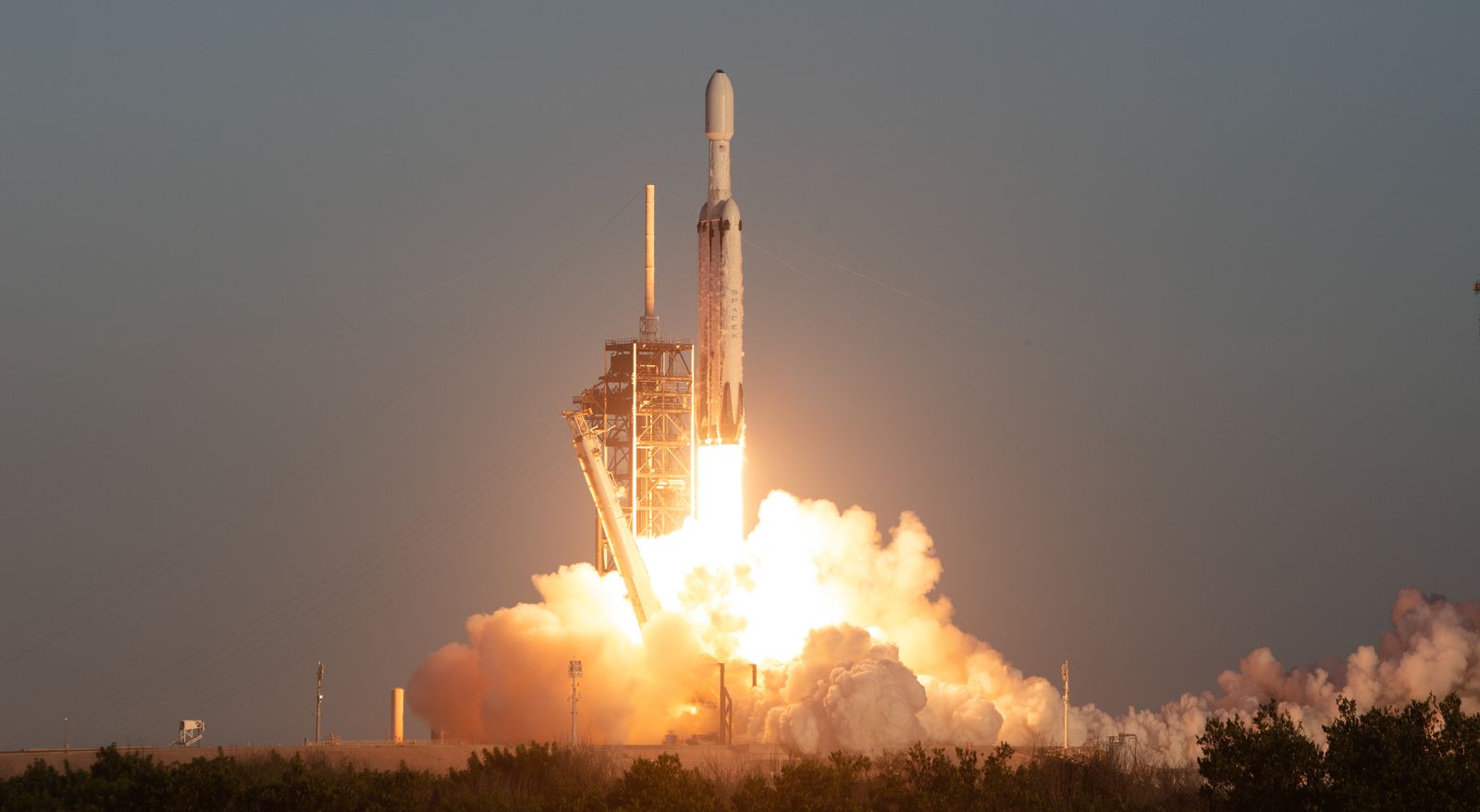
A Falcon Heavy lifts the Roman observatory off Launch Complex 39A at 7:26 in the morning, Eastern time, on 30 August 2026. Thirty-one minutes later the observatory separated and was flying on its own.
Credit: NASA/Joel Kowsky
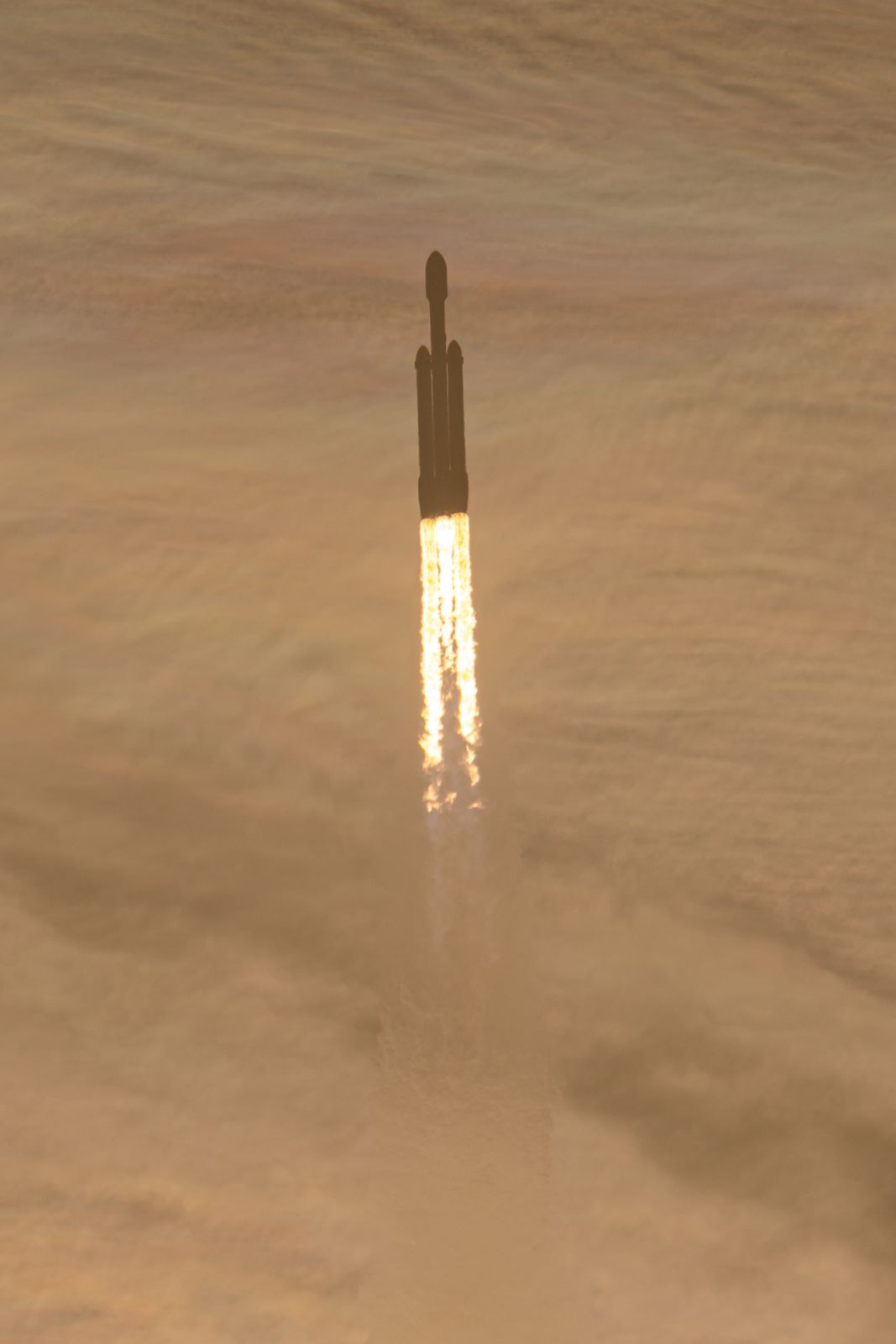
The Roman launch from a second vantage, the twin side boosters that would return to land in Florida.
Credit: NASA/John Kraus
The observatory was finished on the ground before it was finished in fact, and the order of those events is worth keeping straight. On 25 November 2025, technicians joined Roman's inner and outer portions in the largest clean room at NASA's Goddard Space Flight Center, and the observatory was structurally complete; NASA announced the completion on 4 December. The testing that followed was not a formality. In March 2026 the full observatory was blasted with extreme sound, shaken, and subjected to electromagnetic-interference testing, and passed all three. In May 2026 came the final ground deployment tests of the solar array and the aperture cover. In June 2026 the observatory was shipped to Kennedy Space Center, arriving on 21 June.
On 30 August 2026, at 7:26 a.m. Eastern Daylight Time, a SpaceX Falcon Heavy lifted off from Launch Complex 39A at Kennedy Space Center with Roman aboard. NASA's administrator described the mission at launch as delivered ahead of schedule and on budget — on budget, the agency was careful to say, not under it. Communications were acquired seven minutes after liftoff. At 7:57 a.m., thirty-one minutes in, Roman separated from the rocket's second stage and was flying on its own; the two side boosters landed back in Florida. In the minutes after separation Roman deployed its Solar Array Sun Shield, swinging four outer panels into place to complete a six-panel array, and the solar panels and lower instrument sun shade were confirmed deployed about eighty-three minutes after liftoff.
Then the telescope unfolded itself, step by dated step. On 31 August, a first mid-course correction burn of about three minutes adjusted its trajectory toward its final orbit, and that afternoon the high-gain antenna — a carbon-composite dish 5.6 feet wide — completed its deployment, the link that would carry the data home. On 1 September the Deployable Aperture Cover, the visor that shades the telescope's mouth, swung open on three booms; that was the final physical deployment. The same morning, the Coronagraph Instrument was powered on for the first time. On 11 September the Wide Field Instrument began cooling toward operating temperature, its eighteen detectors were activated, and calibration data followed. Between 7 and 17 September the three ground stations that will receive Roman's data — in Japan, New Mexico, and Australia — were tested and confirmed ready.
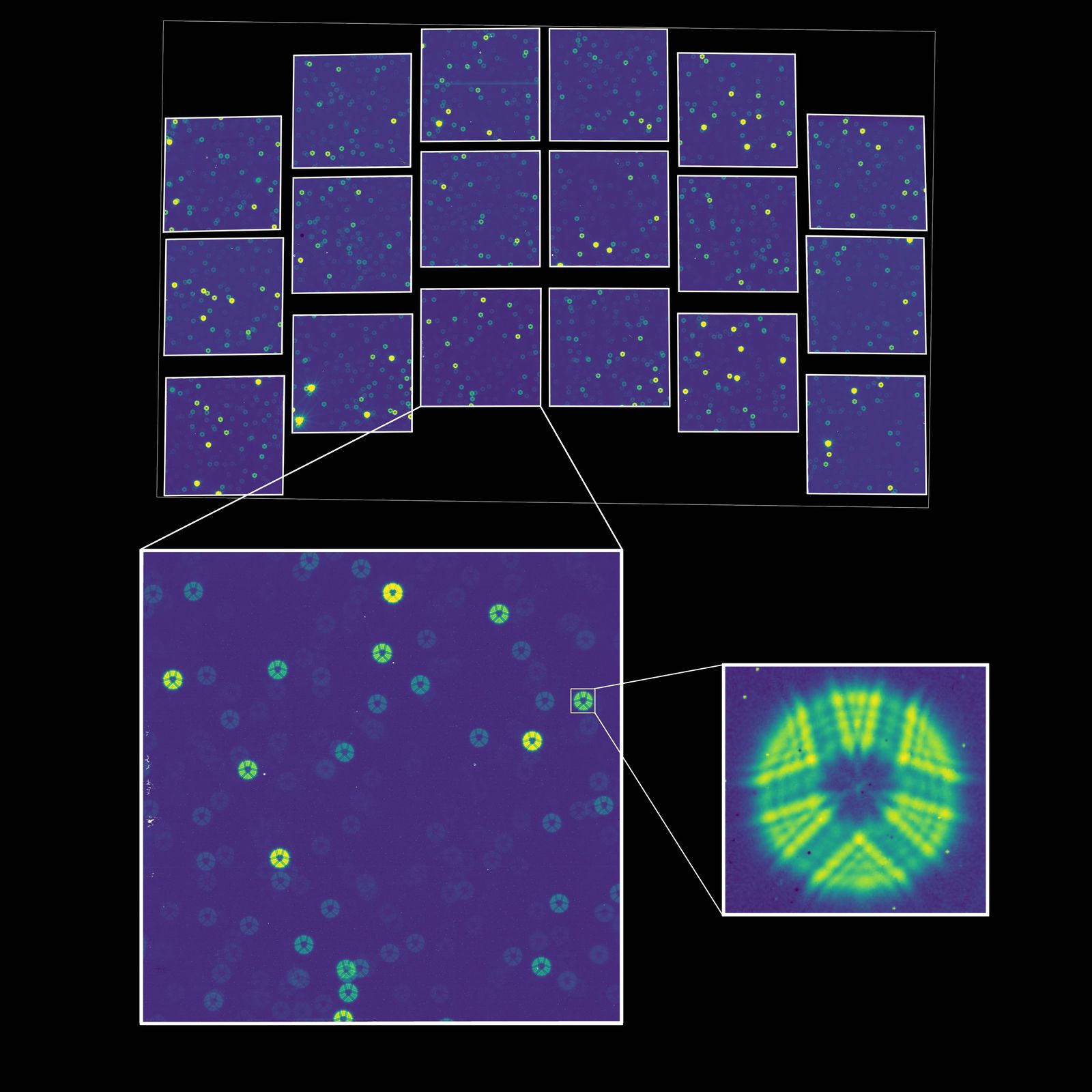
Roman's first photons, recorded by the Wide Field Instrument in September 2026, are an engineering test frame: a sea of out-of-focus stars, each one a ring of light, taken before the telescope reached best focus. The frame's job was to prove the camera was alive. It is not a science image, and this book does not present it as one.
Credit: NASA's Goddard Space Flight Center, Tyler Desjardins (STScI)
What the instruments saw first must be described with care, because these were engineering test frames, not science images. The Wide Field Instrument's first photons, published with NASA's 15 September update, show a sea of out-of-focus stars: rings — donuts — of light, taken while the detector array was still configured as it had been for launch and far from best focus. Their purpose was proof of life, and they provided it. The Coronagraph took its first test observation of cosmic light on 22 September, a faint star in the Large Magellanic Cloud through a still-warm detector, and a second on 27 September with the detector cooled, recording many stars in that galaxy and confirming the pointing. In October the Wide Field Instrument's focus was sharpened by moving the secondary mirror a fraction of a hair's width, and its measured optical quality came in nearly thirty percent better than predicted. On 22 October 2026, NASA announced that Roman had completed its comprehensive checkout, was fully functional, and had entered the science commissioning phase.
The Coronagraph had its own parallel awakening. Woken on 1 September, it spent its first weeks in a thirty-day decontamination period, held near room temperature — about 22 degrees Celsius — while the main camera went cold around it. NASA's mid-September update recorded a first test of its deformable-mirror "limbs," the actuators that will one day hold a star's light cancelled to a hundred-millionth. Its first observations of cosmic light followed on 22 and 27 September, described in the previous paragraph — faint stars in the Large Magellanic Cloud, chosen because that galaxy's crowded fields make a strict test of pointing. By mid-October its focus had been corrected as well, with a demonstration of the deformable mirrors planned for the weeks after. A technology demonstration earns its name in exactly this way: not in one announcement, but in a sequence of small, checked, dated successes.
The checkout had a texture worth recording, because it shows what commissioning actually consists of. Before the Wide Field Instrument could open its eyes, it spent about ten days in a controlled warm-up — a decontamination bake near −65 degrees Celsius — before cooling in stages: the heaters off on 11 September, the detectors brought down past −140 degrees on the way to a final operating temperature near −183 degrees, and the eighteen detectors activated as the cold arrived. The first calibration data came that night and the first test data the next morning; over the following weekend the filter wheel turned for the first time in zero gravity and the focus mechanism moved. The fine guidance sensors were tested between 15 and 21 September and held the telescope's pointing steadier than a ten-thousandth of a degree — stability NASA illustrated as holding a view steady on a dime a hundred and fifty miles away, for half an hour at a time with the main camera and eight hours with the Coronagraph. When the focus was sharpened in October, the secondary mirror was moved by about one sixteenth of the diameter of a human hair, and the camera's measured optical error came in at 63 nanometres against a requirement of about 90 — nearly thirty percent better than predicted. None of this is spectacle. All of it is the difference between a spacecraft and an observatory.
Two facts close the chapter, and this book states them plainly. First, Roman has not yet arrived. Its orbit insertion at the Sun–Earth L2 point, about a million miles from Earth, is expected roughly one hundred days after launch — early December 2026. Second, no Roman science images exist yet. Everything published so far is launch photography, clean-room photography, and engineering test frames. The first science images are expected by early 2027, on NASA's written schedule. A book about what telescopes capture has to be honest about a telescope that has not yet begun to capture — and the honesty is easy, because the waiting is now measured in weeks.
Chapter 12 — The Census to Come
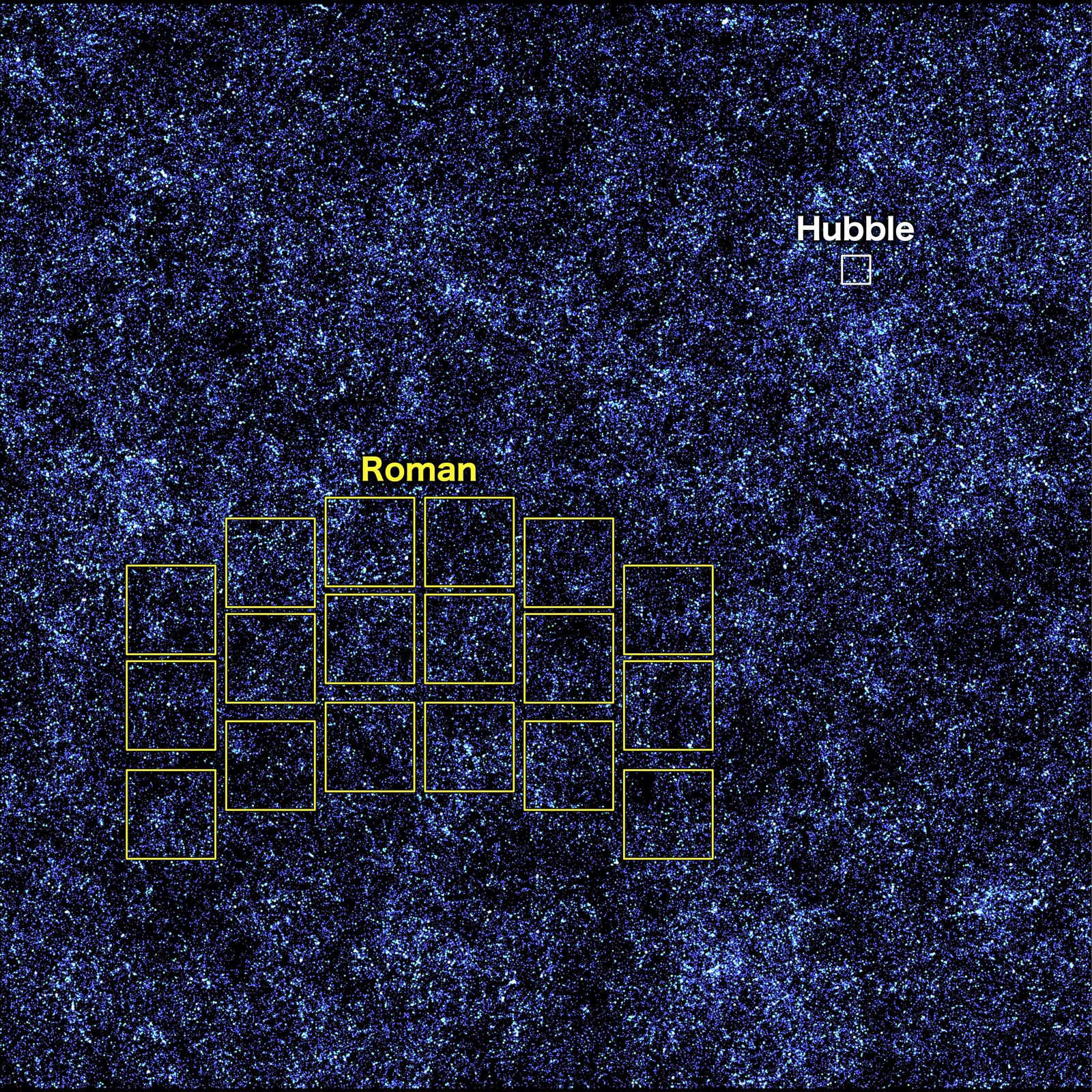
A simulated Roman survey field: more than a billion galaxies are expected across the mission's wide-area surveys, each one measured to the same standard, so that the distortions of their shapes and the pattern of their clustering can be counted as data. The image is a simulation, generated before launch from models — Roman's own census frames are still to come.
Credit: NASA's Goddard Space Flight Center and A. Yung
Hubble's method, across thirty-six years, has been the portrait. An astronomer proposes a target; the telescope stares; the result is one field studied in depth — a nebula, a cluster, a patch of apparently empty sky that turns out to hold thousands of galaxies. Roman's method is the opposite: the census. Instead of choosing targets one at a time, it will photograph enormous areas of sky to the same depth and the same standard, and count what is there. Its surveys are designed to record more than a billion galaxies. The difference is not scale alone. A portrait answers questions about an object. A census answers questions about a population — and the largest open questions in cosmology are population questions.
The first of them is the expansion of the universe. Part One told how two supernova teams found the expansion accelerating in 1998, how Hubble then traced dark energy's history, and how the local and early-universe measurements of the expansion rate still disagree. Roman attacks the problem as a census-taker. Its High Latitude Wide Area Survey will map the shapes of galaxies across a vast area — the technique called weak gravitational lensing, in which the gravity of intervening dark matter slightly distorts each galaxy's image, so that counting distortions across millions of galaxies draws a map of the dark matter itself — together with the clustering of those galaxies in three dimensions. Its High Latitude Time Domain Survey will watch fields repeatedly to catch Type Ia supernovae, the same class of exploding star that revealed the acceleration, but in numbers and at distances no targeted programme could assemble. Dark energy and dark matter are, between them, most of the universe. Hubble showed they were there. Roman will measure them by enumeration.
The second census is of planets. From its station at L2, Roman will stare at the crowded star fields toward the centre of our galaxy, watching for microlensing events — the brief brightening of a background star when a foreground star, and any planets around it, pass in front and bend its light. The Galactic Bulge Time Domain Survey is expected to find more than a thousand wide-orbit planets this way: planets on orbits like the outer planets of our own system, a population other methods barely reach. The same data should record more than a hundred thousand planets crossing the faces of their stars. Microlensing has a particular virtue a census needs — it is indifferent to how faint the host star is, so it counts planets as they are, not as the bright and easy cases present them.
The third task is the Coronagraph's, and it is deliberately the smallest. Across roughly three months of observations in the mission's first eighteen months, the demonstration instrument will image planets directly — worlds up to a hundred million times fainter than their stars — not to complete a survey but to prove the techniques on which a future observatory, built to photograph Earth-like planets, will stand. It is pathfinding, labelled as such.
The census method changes the sociology of the science as well as its statistics. A targeted observatory allocates its time proposal by proposal, and the sky it photographs is the sum of what individual teams thought to ask for. A survey observatory commits its fields in advance, observes them to a uniform standard, and releases everything into a public archive with no proprietary period. Roman's prime mission is expected to produce on the order of twenty petabytes of archived data — a collection so large that a substantial share of Roman science will be done by people who never proposed for a minute of its time, working on fields chosen before the telescope launched. Hubble's archive demonstrated the value of that model across thirty-six years, including discoveries made in data years after it was taken. Roman is built to make the archive the main event from the first day: the surveys are the mission, and the mission's product is a counted sky that anyone may use.
There is a second, quieter consequence. Because the wide-area, time-domain, and bulge surveys measure the universe by several independent methods at once — lensing distortions, galaxy clustering, supernova distances, stellar microlensing — their results can be checked against each other inside a single instrument's calibration. The disagreement between the local and early-universe expansion rates, which Part One left open, is exactly the kind of question such cross-checks exist to settle: not by one heroic measurement, but by several ordinary ones that cannot all be wrong in the same direction.
How long will the census run? The prime mission is five years. The observatory was designed for a five-year extension beyond that, and its fuel was budgeted on that ten-year basis. In September 2026, NASA reported that precise flying had saved so much propellant that the tanks hold fuel for at least twenty-two years of potential operations. That figure needs its label kept on: it is a fuel projection, not an approved mission life. No extension has been granted; what exists is a five-year mission, a designed path to ten, and enough fuel, in principle, for much longer. This book reports all three numbers as what they are.
None of this replaces the elder telescope's trade, and the book's pairing depends on keeping the two distinct. A census establishes what exists and in what proportions; it cannot, by itself, take the ultraviolet spectrum of one interesting galaxy, or stare at one gravitational lens until its structure resolves, or return to one nebula across nineteen years to watch a jet lengthen. Those are portraitist's jobs, and they remain Hubble's — in wavelengths Roman does not even carry. The expected pattern of the next decade is therefore not succession but referral: the census finds the classes, the extremes, and the anomalies; the portraitists — Hubble while it lasts, and targeted instruments after it — take the close-ups. Roman's billion galaxies are, among other things, a finding list for every other telescope of its era.
When does it start? Roman enters its surveys after commissioning at L2, and NASA's written sources put the first science images by early 2027. Until those frames exist, every statement in this chapter is a statement about a designed capability, and the book has kept them in that tense on purpose. Hubble finds and characterises; Roman censuses. The elder telescope is still working its portraits, one gyro and all, while the younger one cools and focuses a million miles out — and the census, when it begins, will be the largest count of the sky ever taken with a single instrument.