Part One — Seeing Further
Chapter 1 — The Long Argument
The idea of putting a telescope above the atmosphere is older than the rockets that could do it. In 1923, the German rocket pioneer Hermann Oberth mentioned propelling a telescope into Earth orbit in his book on rocket flight to the planets. The serious case, though, was made in 1946 by Lyman Spitzer Jr., a Princeton astrophysicist, who set out in a paper what an observatory above Earth's turbulent air could do: see steadily, in wavelengths the atmosphere blocks, without weather or daylight imposed by a rotating planet beneath it. Promoting that idea became, in NASA's phrase, a driving focus of his long career, and he is conventionally called the father of Hubble.
An idea, however, is not an institution. Spitzer supplied the argument; the person who turned it into committees, budgets, and congressional testimony was Nancy Grace Roman. Roman joined the fledgling NASA and, by 1960, was its first Chief of Astronomy — and its first female executive, the first woman in a leadership position at the agency. For the next two decades she led the science and planning committees for what was then called the Large Space Telescope, brought scientists and engineers into the same rooms, briefed executive branch officials, lobbied NASA's own leadership, and wrote the testimony when NASA representatives appeared before Congress. Her pitch, as she liked to put it, was that for the price of one night at the movies each year, each American would receive fifteen years of exciting discoveries. That line is a quip, not a transcript, but it captures the strategy: spread the cost across every citizen and the benefit across a generation. She also made technical calls that lasted. She pushed, for instance, to fit charge-coupled devices — CCDs — as the telescope's image sensors in place of the older sensor technology then standard, a decision the finished observatory would vindicate.
The scientific community formalised its support in 1969, when a National Academy of Sciences report, Scientific Uses of the Large Space Telescope, endorsed the project; Spitzer had spent years gathering astronomer support and answering critics. In 1974 the first working-group meeting took up concepts, budget, and technical requirements, and the Science Working Group set the ambition plainly: interchangeable instruments, resolving a tenth of an arcsecond, working across ultraviolet, visible, and infrared light. It also settled the design decision that would eventually save the observatory's life. Hubble was planned from the start to be serviced — taken apart and upgraded in orbit by astronauts. Astronauts were training for servicing missions as early as 1979. No other major observatory has been built on that principle, and in 1993 it would make the difference between a failure and a recovery.
The resolution target deserves a plain-English translation, because a tenth of an arcsecond is not a unit anyone feels. An arcsecond is 1/3,600 of a degree. A tenth of one is the apparent size of a coin seen from several hundred kilometres away — fine enough to split close double stars, resolve the discs of the giant planets into weather, and read the crowded cores of distant galaxies star by star. The working group was not asking for a somewhat better telescope. It was asking for an instrument an order of magnitude steadier than the atmosphere allows anything on the ground to be, and it was asking in 1974, before the agency that would build it had flown anything like it.
Money shrank the telescope before it built it. Post-Apollo budget pressure in the 1970s forced the primary mirror down from 120 inches (3 metres) to 94 inches (2.4 metres); NASA's own history attributes the reduction to budget constraints. A persistent piece of folklore holds that the size was dictated by spy satellites. The defensible version is narrower: Hubble drew on the same industrial base and mirror-making technology developed for reconnaissance satellites — firms such as Perkin-Elmer and Kodak were the era's large-optics houses for both civil and surveillance work — but the telescope itself was an unclassified, purpose-built observatory, and its diameter was set by its budget, not by another programme's hardware.
Europe came aboard in 1975. The European Space Agency provided about 15 per cent of the funding, contributing the Faint Object Camera and the solar arrays, in return for a guaranteed minimum of 15 per cent of observing time for European astronomers — a partnership that has held for the observatory's entire life. In 1977, Congress approved funding to build the telescope, and the project formally got under way. Grinding of the 2.4-metre primary mirror began in December 1978 at Perkin-Elmer in Danbury, Connecticut. The mirror is Ultra-Low Expansion Glass, 828 kilograms of it, figured to hold a focal length of 57.6 metres folded into a tube 13.2 metres long — about the length of a large school bus. Its aluminium reflecting coat is some three millionths of an inch thick, overcoated with magnesium fluoride to lift its ultraviolet reflectivity.
The industrial-base point deserves one more sentence, because it produced a quiet insurance policy. Perkin-Elmer won the contract to build Hubble's flight mirror; Kodak, the losing bidder and the other great optics house of the reconnaissance era, built a backup mirror instead. The backup was figured correctly. It never flew — by the time anyone knew the flight mirror was wrong, the telescope was in orbit and the cheaper path was to correct the light, not replace the glass — but its existence is a reminder that the flaw of 1990 was never a failure of the era's mirror-making as such. The craft could do the work. One measuring instrument, inside one contractor's process, said the work was other than it was.
In 1983 the Large Space Telescope was renamed for Edwin Hubble, the astronomer whose name attaches to the expansion of the universe, and the Space Telescope Science Institute began operations at Johns Hopkins in Baltimore, created to judge proposals and run the science. The institute mattered more than its administrative description suggests. A telescope above the atmosphere, oversubscribed from birth, needed a standing body to decide whose questions got asked — and to run the observatory as a public instrument rather than a project team's private one. That arrangement, an independent science institute operating a national facility, became the template later observatories inherited, and it is why Hubble's data have always flowed into a public archive rather than a filing cabinet. The industrial work was spread widely: Marshall Space Flight Center led design and development, Perkin-Elmer built the optical telescope assembly and the fine guidance sensors, Lockheed built the spacecraft structure and integrated the telescope, and Goddard led instrument design and ground control — dozens of contractors across 21 states and 12 countries. By 1985 the telescope was assembled and ready.
It then waited. On 28 January 1986 the shuttle Challenger was lost, the fleet was grounded for 32 months, and Hubble's launch slipped with it. The stand-down was not wasted: solar cells were improved, the aft shroud was modified to make instrument swaps easier, computers and communications were upgraded, and the observatory was stress-tested further. The delay carried a cost measured in years, but the telescope that finally flew was better than the one that had been ready in 1985.
The argument had taken forty-four years, from a paper in 1946 to a telescope waiting on the ground — and the telescope it produced had been built, deliberately, to be visited.
Chapter 2 — Launch, and the Flaw
Hubble left Earth on 24 April 1990, aboard the space shuttle Discovery on mission STS-31, with five astronauts, from Kennedy Space Center. The next day it was deployed, lifted from the payload bay by the Canadian-built robotic arm, into a circular orbit roughly 570 kilometres up, inclined 28.5 degrees to the equator. It carried five instruments: the Wide Field and Planetary Camera, its main imager; the Faint Object Camera, Europe's contribution and the highest-resolution ultraviolet-visible camera of its era; two spectrographs, the Faint Object Spectrograph and the Goddard High Resolution Spectrograph, for spreading starlight into its component colours; and the High Speed Photometer, built to measure brightness flickering on millisecond timescales. It weighed 11,110 kilograms at launch. It had been designed for a fifteen-year mission.
The machine itself rewards a moment's attention, because its numbers are human-scale. It travels at about 27,000 kilometres an hour and completes an orbit in roughly 95 minutes, which means its day is an hour and a half long and half of every day is night. Its two solar arrays generate about 5,500 watts in sunlight; the observatory's average draw is about 2,100 watts — roughly a hair dryer's worth — and six nickel-hydrogen batteries carry it through the 25 minutes of eclipse in each orbit. Light falls on the 2.4-metre primary, reflects to a secondary mirror just 0.3 metres across and weighing 12.4 kilograms, and comes back through a hole in the primary's centre to the instruments waiting behind it. Three fine guidance sensors lock onto guide stars to hold the whole assembly steady, and reaction wheels turn it — the telescope carries no thrusters for pointing, and slews by spinning internal wheels against its own mass. Its launch mass of 11,110 kilograms is often rendered as about two adult elephants; servicing would eventually add roughly 3,000 pounds of new equipment to that figure, growth that is itself a record of five visits' worth of new capability. Nothing about the design was exotic. It was a careful, conservative telescope — which is part of why what happened next was so hard to believe.
First light came on 20 May 1990, and even at first sight the camera's images were already about 50 per cent sharper than what ground-based telescopes could produce. (The record of the starting orbit is itself a small lesson in how this book handles numbers: ESA's fact sheet gives the deployment altitude as about 570 kilometres, while some American retrospectives give figures nearer 612 kilometres for the early operating orbit — deployment versus early operations. The difference matters less than the direction: whichever figure opens the account, every later one is smaller.) The trouble showed itself quietly. Star images had a sharp core, but wrapped in a diffuse halo that should not have been there, and both imaging cameras showed the same distortion. If two different instruments see the same defect, the defect is upstream of both: in the mirrors.
On 27 June 1990, two months after launch, NASA announced the diagnosis: spherical aberration. Light reflected from the edge of the primary mirror was coming to a focus at a different point from light reflected from the centre. Instead of one focus, the telescope had a smear of them. By the failure literature's accounting, only about 15 per cent of a star's light was landing in the tight core the design promised, against roughly 70 per cent intended. On 2 July NASA formed the Optical Systems Board of Investigation, chaired by Lew Allen, the director of the Jet Propulsion Laboratory, to find out how a mirror that had passed every test could be wrong.
The mirror, it turned out, had been polished superbly — to the wrong shape. Its edge was too flat, by about 2 micrometres: roughly one-fiftieth the width of a human hair, spread across a surface 2.4 metres wide. That error sounds like nothing until it is set against the tolerance the mirror was built to, which it exceeded tenfold. A mirror is a machine for agreeing about where light goes, and an error of 2 micrometres is enough to break the agreement.
The cause was not the polishing. It was the measuring. During fabrication, the mirror's figure was defined by an instrument called a reflective null corrector — a device that simulates the perfect mirror's behaviour so the real one can be ground to match. Investigators found that corrector still undisturbed in its 1981 configuration, nine years on, and reverse-engineered the flaw from it: the corrector had been mis-assembled, with a lens spacing error of 1.3 millimetres. (Accounts derived from the investigation add a vivid detail — that a spacing measurement was thrown off where a laser reflected from a spot on a metering-rod end cap whose coating had flaked. The 1.3-millimetre error itself is NASA's stated finding; the flaked coating belongs to the investigation reporting.) The mirror had been ground, faithfully and precisely, into the shape a faulty measuring instrument described.
The harder finding was organisational. The reflective null corrector had not been the only test. Two auxiliary devices — a refractive null corrector and an inverse null corrector — had both, during fabrication, indicated spherical aberration in the mirror. Those results were discounted in favour of the primary instrument's readings, and, as the board found, the discrepant data never reached the managers who might have acted on it. The flaw in Hubble was, in other words, two flaws: a mis-assembled instrument, and a system in which contrary evidence could be set aside without anyone in authority knowing it existed. The glass was honest. The measurement chain was not.
Even flawed, the telescope worked. In August 1990, still trailing its halo, Hubble resolved the ring around Supernova 1987A, the exploded star that had been the brightest supernova visible from Earth in centuries. In October 1990 the first Hubble science paper was submitted — Tod Lauer's study of the environment of a suspected black hole in the galaxy NGC 7457. Astronomers learned to extract real science from the blurred images, and the archive of the broken years is not worthless. But the observatory that had been sold to the public as the sharpest eye ever flown was producing, in its most visible output, visibly soft pictures, and everyone who had funded the forty-four-year argument knew it.
There was also a scheduling fact pressing on everyone involved, though it is rarely mentioned in accounts of the flaw. Hubble had been designed for a fifteen-year mission, and the clock on that design life was already running. Every year spent blurred was a year subtracted from a finite total — and the instruments, gyroscopes, and batteries were ageing on the same schedule whether the images were sharp or not. A fix that arrived in 1998 would have rescued a telescope with much of its planned life already spent. A fix that arrived in 1993 would hand back nearly the whole mission. The repair, when it came, would have to be early as well as right.
What saved Hubble was not a better mirror. The mirror could not be swapped; it was never designed to be. But the instruments behind it had been designed for exactly that, and the mirror's flawed light could be intercepted and corrected downstream, before it reached them. That distinction — an irreplaceable mirror feeding replaceable instruments — was the whole game.
Chapter 3 — The Repair
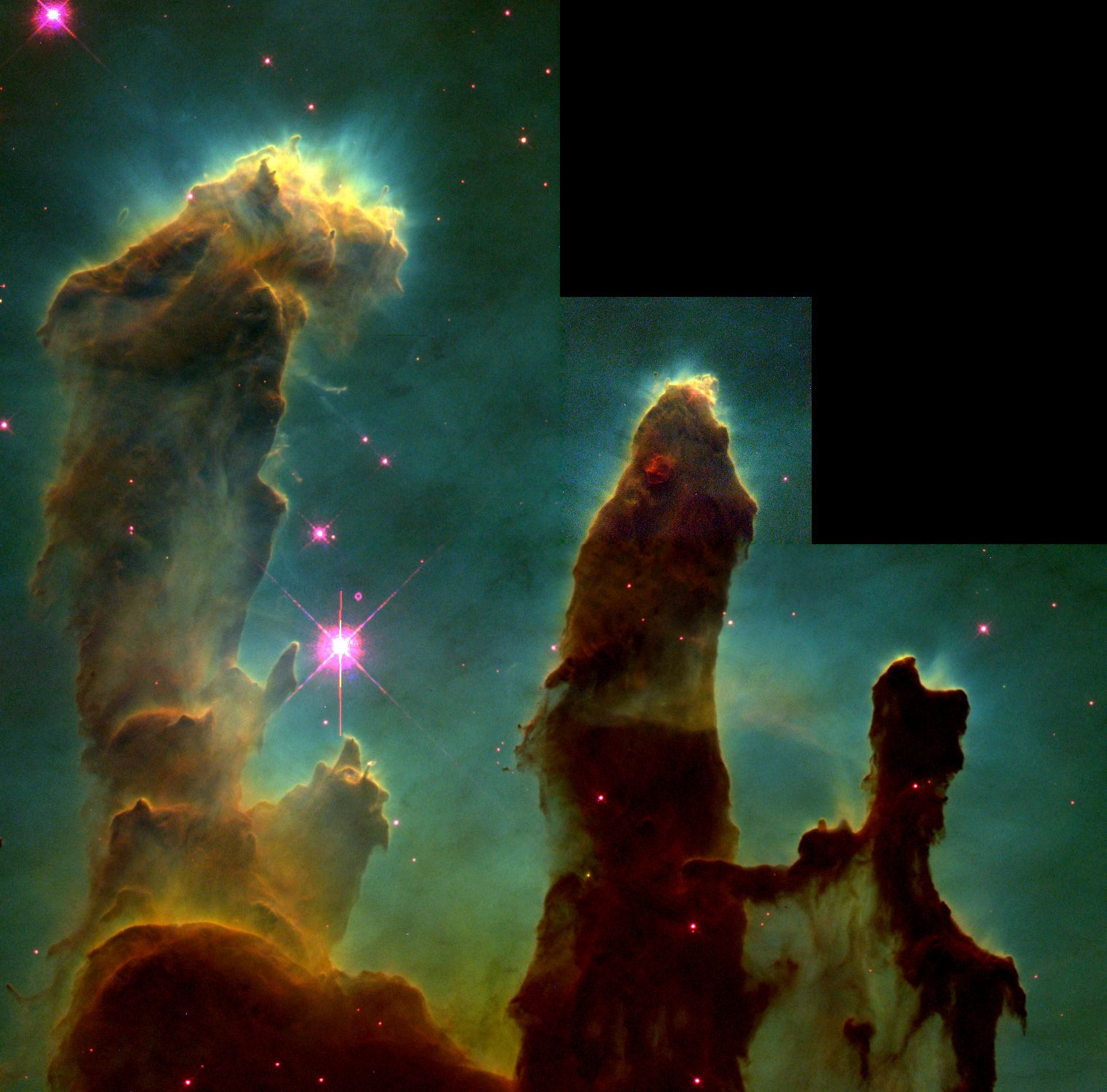
Plate 1 — Pillars of Creation (original). Three columns of cold gas in the Eagle Nebula, some 6,500 to 7,000 light-years away, lit by young massive stars, with newborn stars emerging from evaporating globules — "EGGS" — at the columns' tips. The Wide Field and Planetary Camera 2, the camera built to correct Hubble's flawed mirror, exposed this image on 1 April 1995; it was released on 2 November 1995.
Credit: Jeff Hester and Paul Scowen (Arizona State University), and NASA/ESA
The repair flew on 2 December 1993. Servicing Mission 1, mission STS-61 aboard Endeavour, carried seven astronauts who would make five spacewalks totalling more than 35 hours — at the time, one of the most complex missions the shuttle programme had attempted. They were not swapping a part. They were fitting a prescription.
It is worth pausing on why a prescription was even possible. Hubble had been designed, from the 1970s working groups onward, to be serviced: its instruments were built as replaceable units meant to be swapped in orbit, and astronauts were training for servicing missions from 1979, a decade before launch. When the mirror proved flawed, that design decision converted a catastrophe into a work order. A monolithic telescope with the same flaw would simply have been a failed telescope, written off in place. Hubble could be opened. The repair mission was not an improvisation after disaster; it was the contingency the designers had built the whole observatory around, flown three and a half years after deployment.
What COSTAR restored, instrument by instrument, is worth naming, because the three instruments it served were not spares. The Faint Object Camera was Europe's contribution and the highest-resolution ultraviolet-visible camera of its era. The Faint Object Spectrograph spread the light of faint objects from the ultraviolet toward the near-infrared. The Goddard High Resolution Spectrograph was a ultraviolet specialist of the highest spectral resolution. Through 1993 all three had been looking through the aberration with no remedy of their own; each received, from COSTAR, its own pair of corrective mirrors, figured for its own light path. All three went back to work — and all three, in time, would be retired honourably by replacement rather than by failure: the two spectrographs in 1997, the Faint Object Camera in 2002, as the last original instrument aboard.
The correction came in two forms, and the standard analogies are accurate enough to keep. The first was a replacement camera, the Wide Field and Planetary Camera 2, built with the aberration measured and compensated inside its own optics — a contact lens, ground for one specific eye. The second was COSTAR, the Corrective Optics Space Telescope Axial Replacement: a refrigerator-sized unit that took the place of the High Speed Photometer and deployed pairs of small mirrors — described in NASA's history as nickel- and quarter-sized — into the light paths of the three instruments it did not replace: the Faint Object Camera, the Faint Object Spectrograph, and the Goddard High Resolution Spectrograph. COSTAR was the spectacles; WFPC2 was the contact lens. The High Speed Photometer, it is worth recording, gave up its seat for the spectacles: the instrument sacrificed so that the others could see.
The crew also fitted new solar arrays — the second-generation arrays, SA2 — and attended to gyroscopes and other maintenance. The division of labour across the five spacewalks is worth a sentence, because it shows the mission's true shape: this was not one repair but a programme of work — a camera exchanged, a refrigerator-sized optical bench installed in a vacated instrument bay and its arms deployed into three separate light paths, power hardware renewed, pointing hardware serviced — each task useless without the others, and the whole of it choreographed to the minute. Missions since have been longer and further away; few have carried a payload of consequence this concentrated. Hubble was released back into its orbit, and then everyone waited for the pictures. On 13 January 1994, NASA announced the result: the aberration was corrected, the images crisp and clear. It is difficult to overstate what that announcement closed. A project that had become a public byword for expensive failure was, in the space of one mission, again what it had been promised to be: the sharpest astronomical eye humanity had ever operated.
Technically, COSTAR deserves a clarifying note, because it is often misdescribed as a camera or a lens. It took no images and gathered no science of its own. It was corrective optics and nothing else: a set of small, precisely figured mirrors on deployable arms, positioned to intercept the flawed light before it reached three of the original instruments and re-shape each beam on its way in. Each instrument it served got its own pair of mirrors, figured for that instrument's light path. The mirrors could be small because they intercepted only the narrow pencil of light bound for one instrument — correcting the beam where it was narrow, not where it was wide. That economy, correcting the light late with small optics instead of refiguring the great mirror, is the engineering idea at the heart of the whole rescue. When later instruments arrived with the correction built into their own optics, COSTAR's arms had nothing left to correct — which is why, sixteen years after its installation, a later crew could unplug it and bring the era of the spectacles to a close.
The proof entered the culture the following year. Working through the repaired camera, astronomers imaged three columns of cold gas in the Eagle Nebula, some 6,500 to 7,000 light-years away — the Pillars of Creation — exposed on 1 April 1995 and released that November. The columns stand where massive young stars nearby are evaporating them; at their tips, dense globules of gas — evaporating gaseous globules, EGGS in the literature's unlovely acronym — are boiling away to expose newborn stars inside. The image became the observatory's public face, reproduced beyond counting. But its first significance was narrower and more important: the Pillars were taken with WFPC2, the camera built to carry the correction, which is why they belong in this chapter. They are what a fixed telescope looks like. The same camera went on to take the Hubble Deep Field, and most of the observatory's 1990s icons, and it kept working until 2009. It now sits in the Smithsonian National Air and Space Museum, described there, fairly, as the camera that saved Hubble.
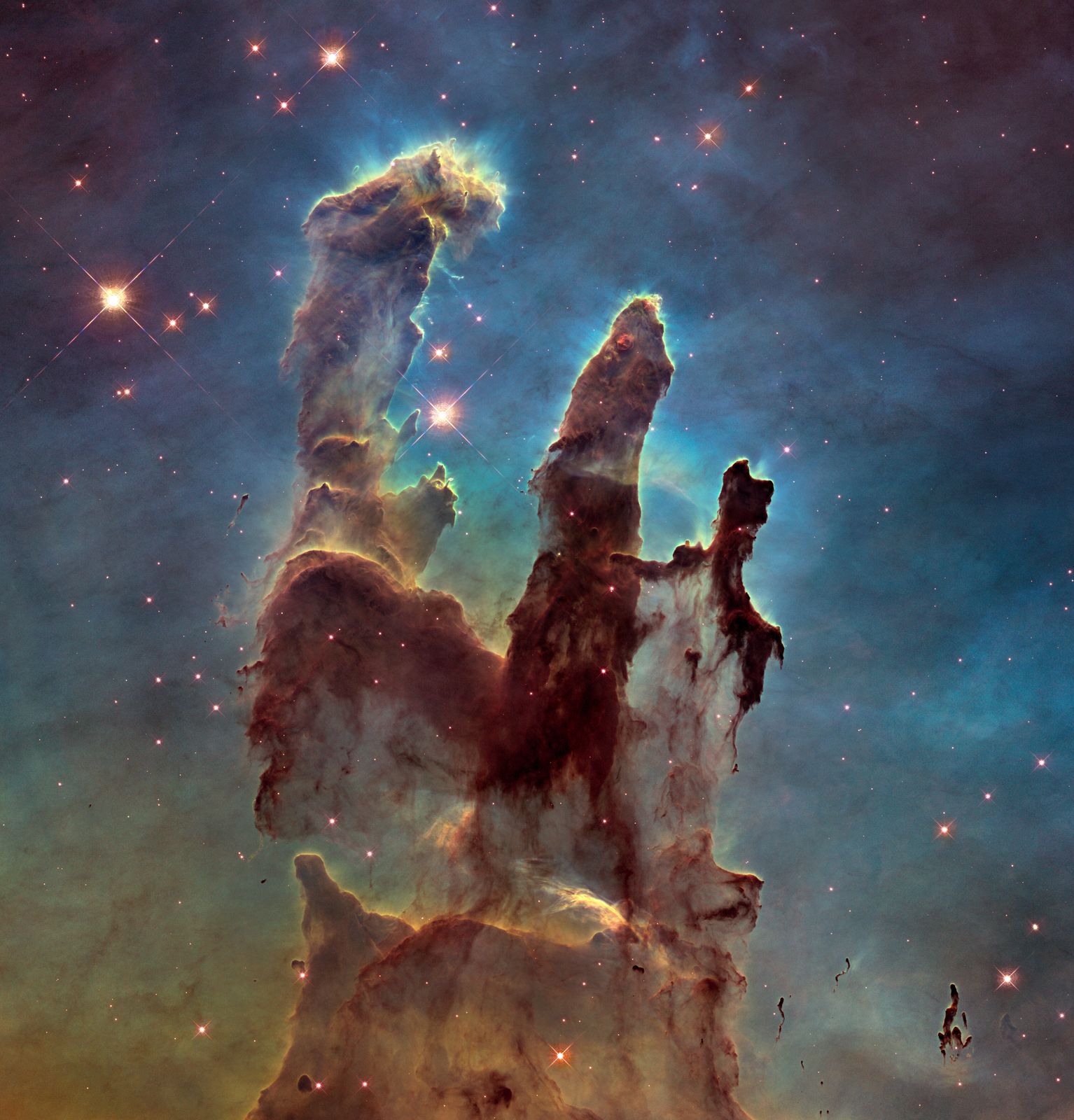
Plate 2 — Pillars of Creation (revisit). The same field, imaged again in visible light by the Wide Field Camera 3 in September 2014 and released on 5 January 2015 for Hubble's 25th anniversary — sharper, wider, and showing a jet from a newborn star lengthened by some 60 billion miles since 1995. Set beside the 1995 frame at the same scale, it is the servicing story told in a single comparison.
Credit: NASA, ESA/Hubble and the Hubble Heritage Team
The Pillars also give this book its before-and-after. In September 2014, Hubble's third-generation camera, WFC3, returned to the same field and imaged it again, sharper and wider, for the observatory's 25th anniversary — in visible light, and in a near-infrared companion view that looks through much of the columns' dust to the stars forming inside it. Put the 1995 and 2014 frames at the same scale and the whole servicing story is visible in one comparison — and the field itself has changed in the interval: a jet from a newborn star in the frame had lengthened by some 60 billion miles between the two exposures. The telescope was repaired; the sky did not hold still for it.
COSTAR's own story ended quietly. Every instrument installed after 1993 carried its correction within itself, so by 2009 the spectacles were redundant, and on the final servicing mission the crew removed COSTAR to make room for a new spectrograph. COSTAR, too, is in the Smithsonian now, alongside the camera. The two devices that fixed the most famous flaw in the history of astronomy are museum pieces you can stand in front of — which may be the most fitting summary of the episode. The flaw was real, the fix was real, and both are history.
What the repair actually purchased was not an apology; it was thirty more years of work.
Chapter 4 — Five Visits
Servicing Mission 1 had been a rescue. The four missions that followed turned rescue into routine — except that nothing about them was routine. Each visit replaced instruments wholesale, and the practical consequence is worth stating plainly: by the end of the fifth visit, the telescope returning the best images in astronomy contained almost none of its original 1990 science hardware. Hubble was not maintained. It was successively rebuilt.
Servicing Mission 2 flew on Discovery in February 1997 and widened the telescope's reach in wavelength. The Space Telescope Imaging Spectrograph, STIS, replaced the Faint Object Spectrograph, and the Near Infrared Camera and Multi-Object Spectrometer, NICMOS, replaced the Goddard High Resolution Spectrograph. Hubble gained proper near-infrared capability and a far more capable spectrograph: STIS, able to take spectra of many objects at once across ultraviolet, visible, and near-infrared light, became the observatory's principal black-hole hunter, reading the motion of gas around galactic nuclei. The crew also renewed engineering hardware — a recorder, a fine guidance sensor, a reaction wheel among it — because a servicing visit has always been two missions in one: new science instruments above, new plumbing below. NICMOS itself had a chequered career that previews the pattern of this chapter: its solid-nitrogen coolant ran out early, in 1999, after a thermal short in its dewar, and Hubble's infrared eye went blind until a later crew revived it with a mechanical cryocooler — a refrigerator, installed in orbit, to do the job the expended coolant no longer could. (An odd footnote of the era: in October 1998, Discovery flew the Hubble Orbiting Systems Test — not a servicing mission, but a flight, with John Glenn aboard, to validate hardware planned for the next visit. Most timelines omit it entirely.)
The next visit had to be split in two, because the telescope failed while waiting for it. On 13 November 1999 the fourth of Hubble's gyroscopes failed, and the observatory put itself into safe mode and stopped doing science. A telescope that cannot hold its pointing cannot observe, and with too few gyros Hubble could not hold its pointing. Servicing Mission 3 became SM3A, an urgent December 1999 flight on Discovery whose crew replaced all six gyroscopes, fitted a new main computer — described in mission accounts as roughly twenty times faster than the one it replaced — six battery voltage and temperature improvement kits, a solid-state recorder, a new transmitter, a replacement fine guidance sensor, and fresh insulation. The split had a cost beyond the emergency: everything else planned for that visit, the new camera above all, waited more than two further years for the second half of the mission to fly.
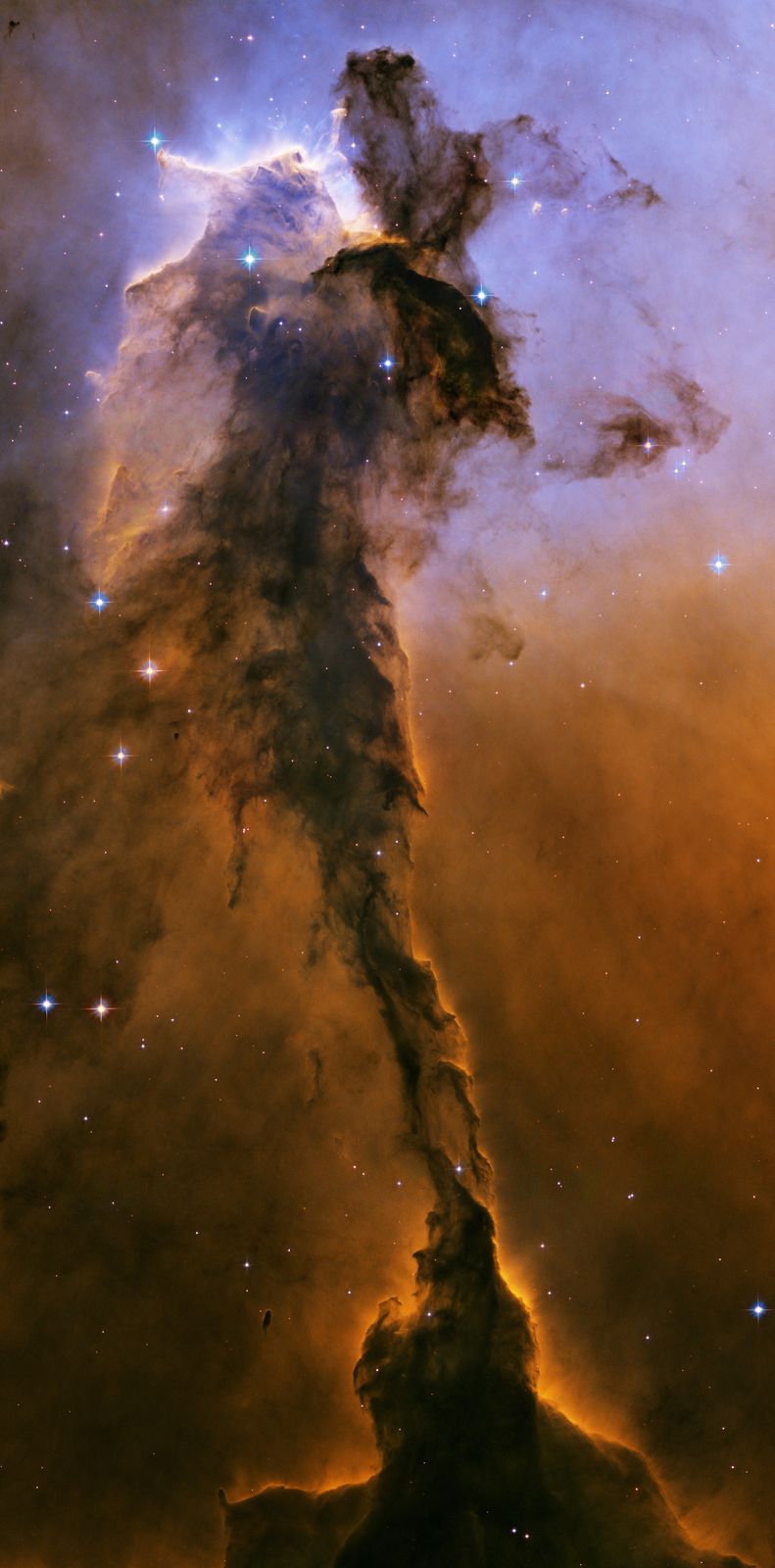
Plate 16 — Eagle Nebula tower. A cold-gas tower nine and a half light-years tall in the Eagle Nebula, imaged by the Advanced Camera for Surveys for Hubble's 15th anniversary and released on 25 April 2005. It is a different structure from the Pillars, taken by the camera whose installation, in 2002, removed the last of Hubble's original instruments.
Credit: NASA, ESA, and The Hubble Heritage Team (STScI/AURA)
SM3B followed in March 2002, aboard Columbia. Its centrepiece was the Advanced Camera for Surveys, ACS, which replaced the Faint Object Camera — the last of Hubble's original 1990 instruments to leave the observatory. ACS had roughly ten times the discovery power of the camera it succeeded, and it would go on to take the Ultra Deep Field. The crew fitted the new rigid, more powerful solar arrays the telescope still flies with, revived NICMOS with a mechanical cryocooler after its original coolant had run out early, and replaced the Power Control Unit — a job that required, for the first time, shutting the entire telescope down on orbit and bringing it back up. This flight also gave Hubble its last orbital reboost. No visiting vehicle has raised its orbit since 2002, a fact that decides the terms of Chapter 7.
On 1 February 2003, Columbia was lost on re-entry with its crew. Among the consequences: the final servicing mission, SM4, was cancelled in January 2004, because a flight to Hubble could not reach the International Space Station as a safe haven if the shuttle were damaged. Without SM4, the telescope's remaining instruments began to fail on schedule and then ahead of it. STIS lost power in August 2004. In January 2007 an electronics failure disabled the two most-used channels of ACS — though its far-ultraviolet Solar Blind Channel kept working, a partial survival that would matter in 2026, when that same camera made the decisive observation of Hubble's late career. Public and scientific pressure built, and on 31 October 2006 NASA reinstated the mission. Even then the failures kept pace: in September 2008, with SM4 weeks from launch, the unit that formats and routes Hubble's science data failed, the telescope went into safe mode again, and the mission stood down while engineers prepared a flight-ready spare from a ground unit.
SM4 flew at last on 11 May 2009, aboard Atlantis, and it was the most ambitious of the five. The crew installed two new instruments: the Wide Field Camera 3, WFC3, the versatile imager that has since taken most of modern Hubble's pictures, including the 2014 Pillars; and the Cosmic Origins Spectrograph, COS, the most sensitive ultraviolet spectrograph ever flown, which took the slot vacated by COSTAR. WFC3's numbers state what a generation means in practice: working two channels, one for ultraviolet and visible light and one for the near-infrared, it is some 35 times more sensitive in the ultraviolet than the camera that saved Hubble, and between seven and sixteen times more efficient at making discoveries. It replaced that camera — WFPC2 came home in WFC3's place in the manifest — which closes a loop this book has been following since Chapter 3: the contact lens was retired by its own successor. Then they did something servicing had never attempted: they opened two dead instruments and repaired them at the level of their circuit boards, on orbit, with tools built for the purpose. STIS and ACS — both silent, neither designed to be serviced this way — were revived. The crew also replaced all six gyroscopes again, fitted new batteries, a fine guidance sensor, and a replacement for the failed data-formatting unit, renewed the insulation, and attached a soft-capture ring: a docking target for a future vehicle that might one day come to dispose of the telescope safely. Hubble was released on 19 May 2009, and its early-release images that September — the Butterfly Nebula, Stephan's Quintet, Omega Centauri — served as the receipt.
Read across all five manifests, a pattern emerges that explains the observatory's longevity better than any single mission does. No visit was purely a science upgrade and none was purely a repair. New instruments always arrived alongside new gyroscopes, batteries, recorders, insulation, or computers — the life-support renewed in the same flights that renewed the science. Hubble's operators never had to choose between keeping the telescope alive and keeping it current, because the servicing programme, from its 1970s conception, treated the two as one job. When the visits stopped, both kinds of renewal stopped together, which is why the chapters after this one are about rationing.
The instrument generations, compressed, tell the story: 1990's camera, spectrographs, and photometer; 1993 and 1997's corrected camera, imaging spectrograph, and infrared instrument; 2002 and 2009's survey camera, wide-field camera, and ultraviolet spectrograph. Five visits across sixteen years had turned a flawed telescope into a succession of new ones wearing the same mirror. The telescope even gained weight in the process — from 11,110 kilograms at launch to roughly 12,247 kilograms after SM4, three thousand pounds of accumulated new capability riding on the same 2.4-metre mirror.
And after May 2009, no one would ever come again — the shuttles retired in 2011, and everything Hubble has done since, it has done alone.
Chapter 5 — What Hubble Found
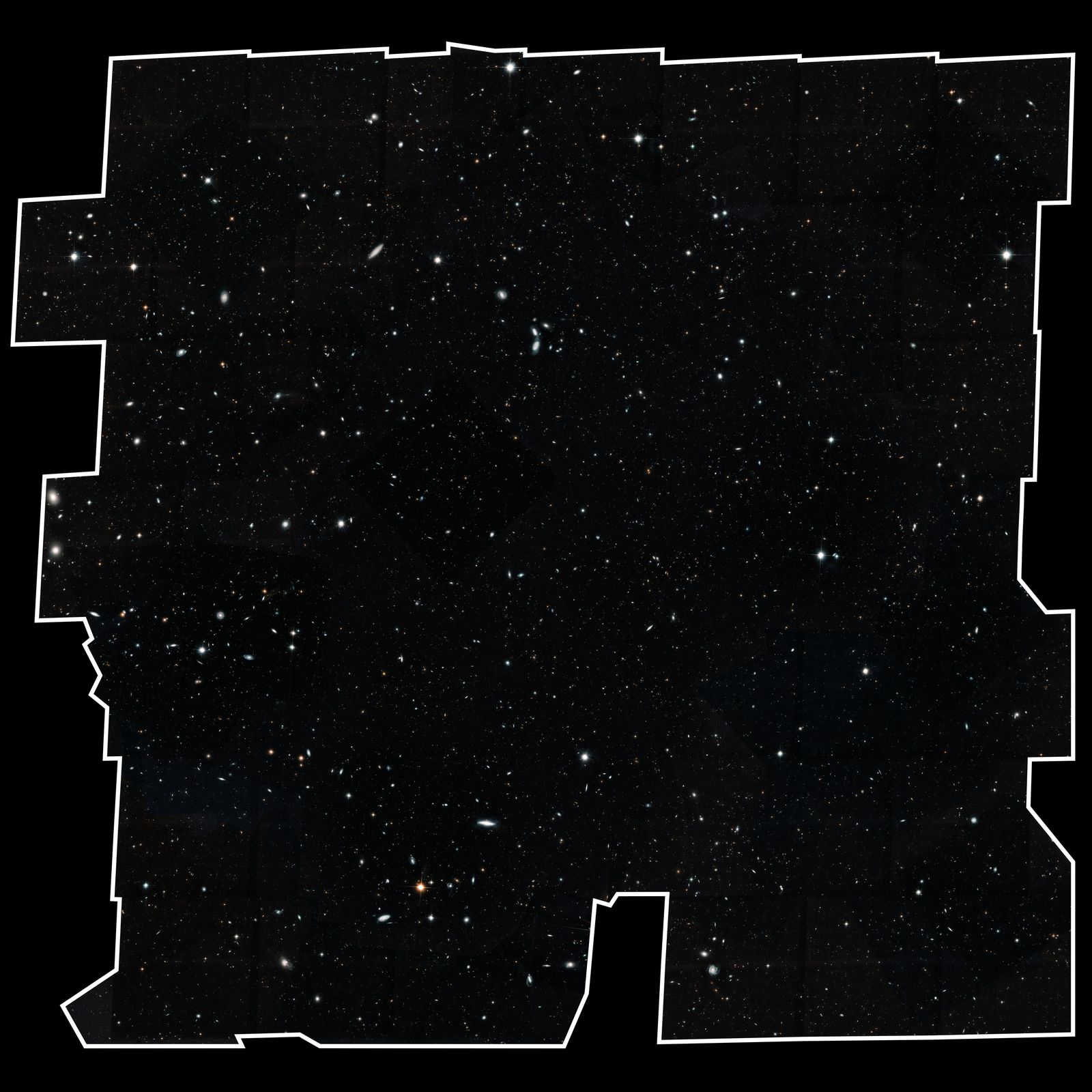
Plate 6 — Hubble Legacy Field. The widest of Hubble's deep views: some 265,000 galaxies reaching back to 500 million years after the Big Bang, woven from about 7,500 exposures across sixteen years and 31 observing programmes, spanning ultraviolet to near-infrared light. Released on 2 May 2019, from Advanced Camera for Surveys and Wide Field Camera 3 data. The eXtreme Deep Field lies inside this frame.
Credit: NASA, ESA, and G. Illingworth (University of California, Santa Cruz; UCO/Lick Observatory)
Start with the number the telescope was, in a sense, built to produce. Before Hubble, the measured expansion rate of the universe was so uncertain that the universe itself could be anywhere from 10 to 20 billion years old — a range wide enough to swallow the ages of its own oldest stars. Hubble's Key Project set out to close that range by measuring Cepheid variable stars in other galaxies with a precision ground telescopes could not match, building the distance ladder rung by rung. The error bars shrank year by year, and the age of the universe settled at 13.8 billion years. Astronomy went from not knowing the age of everything within a factor of two to knowing it within a few per cent, and Hubble's measurements did most of that work.
The expansion story then took the turn nobody's instruments were built to expect. In 1998, two teams studying distant supernovae — Adam Riess's High-z Supernova Search Team and Saul Perlmutter's Supernova Cosmology Project — found, working mainly with ground-based telescopes, that the expansion of the universe is accelerating. Retellings often hand this discovery to Hubble outright; the record does not. Hubble supported the work, and then did something the discovery itself could not: it read dark energy's history. By measuring supernovae far enough away to see the universe as it was 9 billion years ago, Hubble showed that dark energy was already at work then — it is not a recent arrival — and that the expansion first decelerated under gravity and only began accelerating some five to six billion years ago, when dark energy overtook it. That pattern matches the behaviour of Einstein's cosmological constant. Riess, of the Space Telescope Science Institute and Johns Hopkins, shared the 2011 Nobel Prize for the acceleration discovery.
The measurement Hubble made famous is, at press time, also the site of a live dispute — and a November 2026 book should say so. The local distance ladder, built on Hubble's Cepheid measurements and supernovae, puts the present expansion rate at about 73 kilometres per second per megaparsec; a 2026 consensus report from the Local Distance Network puts it at 73.50 ± 0.81. Rival distance ladders, using different stellar indicators and including Webb data, land nearer 70. The early universe, read through the European Space Agency's Planck satellite and the standard cosmological model, predicts 67.4. The gap between about 73 and 67.4 is around 9 per cent and now exceeds five standard deviations: too large, the argument runs, to be measurement error. In 2023–24 the Webb telescope checked Hubble's Cepheid photometry directly and agreed with it, ruling out the favourite mundane explanation — unrecognised crowding of stars in the Cepheid fields — at high significance. So the discrepancy looks less like a Hubble error and more like physics the standard model does not contain. The Hubble tension is unresolved, and it is, in part, Hubble's own measurement refusing to go away.
Black holes underwent a similar change of status: from suspected objects to a census. In 1992 Hubble imaged the accretion disk fuelling a suspected black hole in the galaxy NGC 4261. On 25 May 1994 it confirmed a supermassive black hole at the heart of M87 — a rapidly rotating, collapsed object pinwheeling gas at its core. In 1997 STIS caught the spectroscopic signature of the same phenomenon in M84. Across many galaxies the pattern consolidated into a rule: essentially every large galaxy carries a central black hole, and its mass tracks the mass of the galaxy's bulge. In August 2006, Hubble, the Chandra X-ray observatory, and ground telescopes together produced direct empirical evidence for dark matter in the Bullet Cluster, where gravitational lensing showed the cluster's mass residing apart from its hot gas — mass where no visible matter was.
Hubble also, more or less single-handedly, opened the study of exoplanet atmospheres. In 2003 it watched the hot Jupiter HD 209458b evaporating, its atmosphere streaming away in a comet-like tail of hydrogen — the first evaporation of a planet's air ever observed. In 2007 it found the fingerprint of haze in the atmosphere of HD 189733b. In March 2008, NICMOS detected methane there: the first organic molecule identified on a planet of another star, followed within the year by carbon dioxide on the same world. In November 2008 came Fomalhaut b, among the first exoplanets ever imaged directly in visible light. A field that did not exist when Hubble launched now runs substantially on methods Hubble pioneered.
Closer to home, the same decades collected a set of firsts that rarely make the summaries. In July 1994 Hubble watched the fragments of Comet Shoemaker–Levy 9 strike Jupiter — the first collision of two Solar System bodies ever witnessed as it happened. In 1994 it found the first surface features on Saturn's moon Titan, and in 1996 on Pluto. In 1995 it detected oxygen in the atmosphere of Jupiter's moon Europa. In January 1996 it produced the first direct image of another star's surface — Betelgeuse, with an unexplained hot spot on it. Beginning in 2005 it discovered four of Pluto's five known moons, and new rings and moons of Uranus. And in 2002–03 it photographed one of its strangest sights almost by accident: the star V838 Monocerotis, which had briefly flared to some 600,000 times the Sun's brightness, lighting up shells of surrounding dust in expanding rings — a light echo, whose time-lapse turned the dust around a star into a three-dimensional map. None of these results required the telescope to be the largest of its era. They required it to be above the atmosphere, sharp, and — above all — still there.
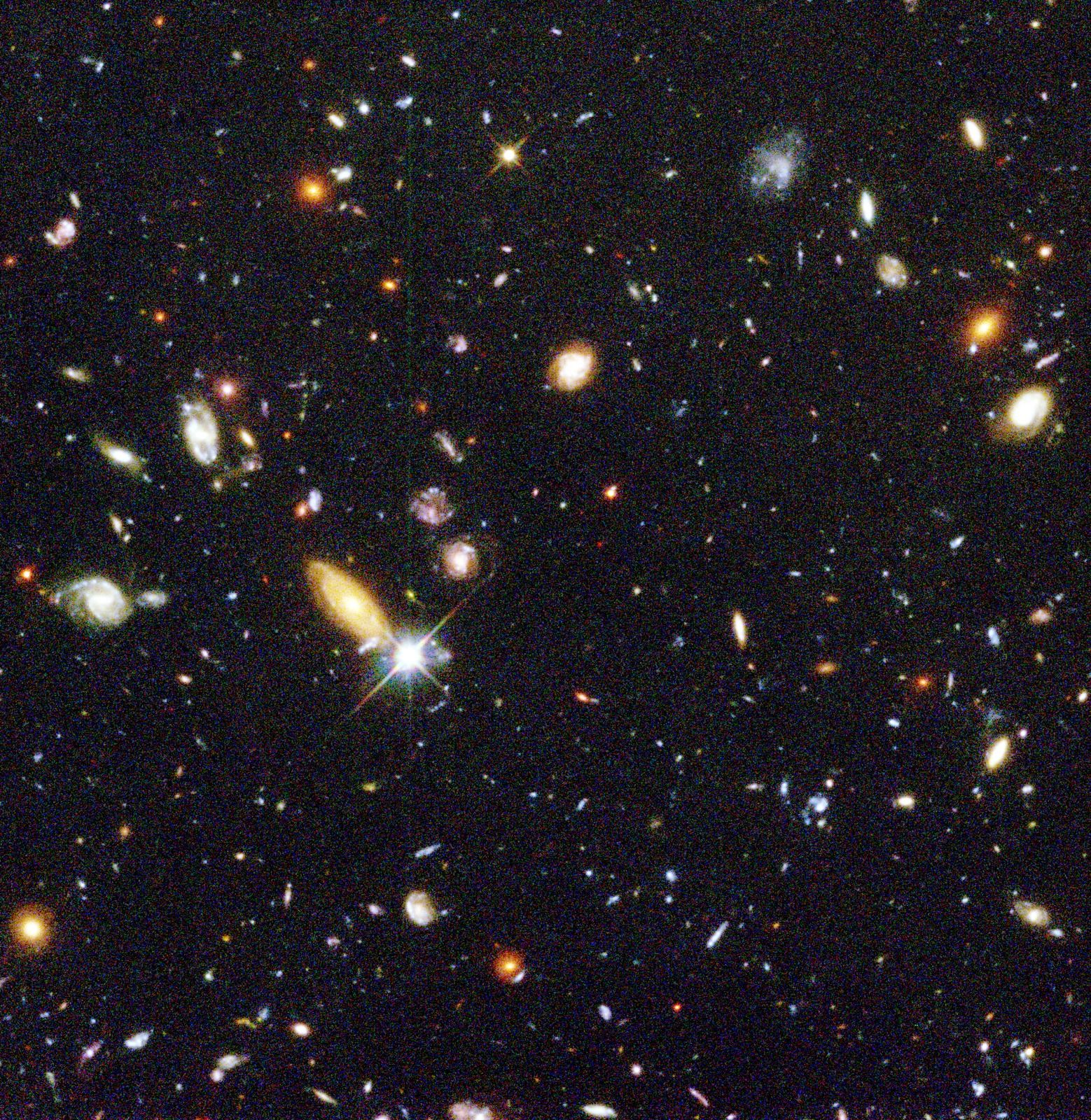
Plate 3 — Hubble Deep Field. Some 3,000 galaxies in a patch of apparently empty sky in Ursa Major — a field the size of a grain of sand held at arm's length — some of them among the youngest galaxies known. The Wide Field and Planetary Camera 2 took 342 exposures over ten days, 18 to 28 December 1995; the image was released on 15 January 1996.
Credit: Robert Williams and the Hubble Deep Field Team and NASA
And then there are the deep fields — the discovery engine, and a story about institutional nerve. In December 1995 the institute's director, Robert Williams, committed a large share of his Director's Discretionary Time to pointing the repaired telescope at a patch of sky chosen for its emptiness, for ten days. Colleagues feared a career-ending blank frame. The Hubble Deep Field, released in January 1996, held some 3,000 galaxies in a speck of sky the size of a grain of sand held at arm's length.
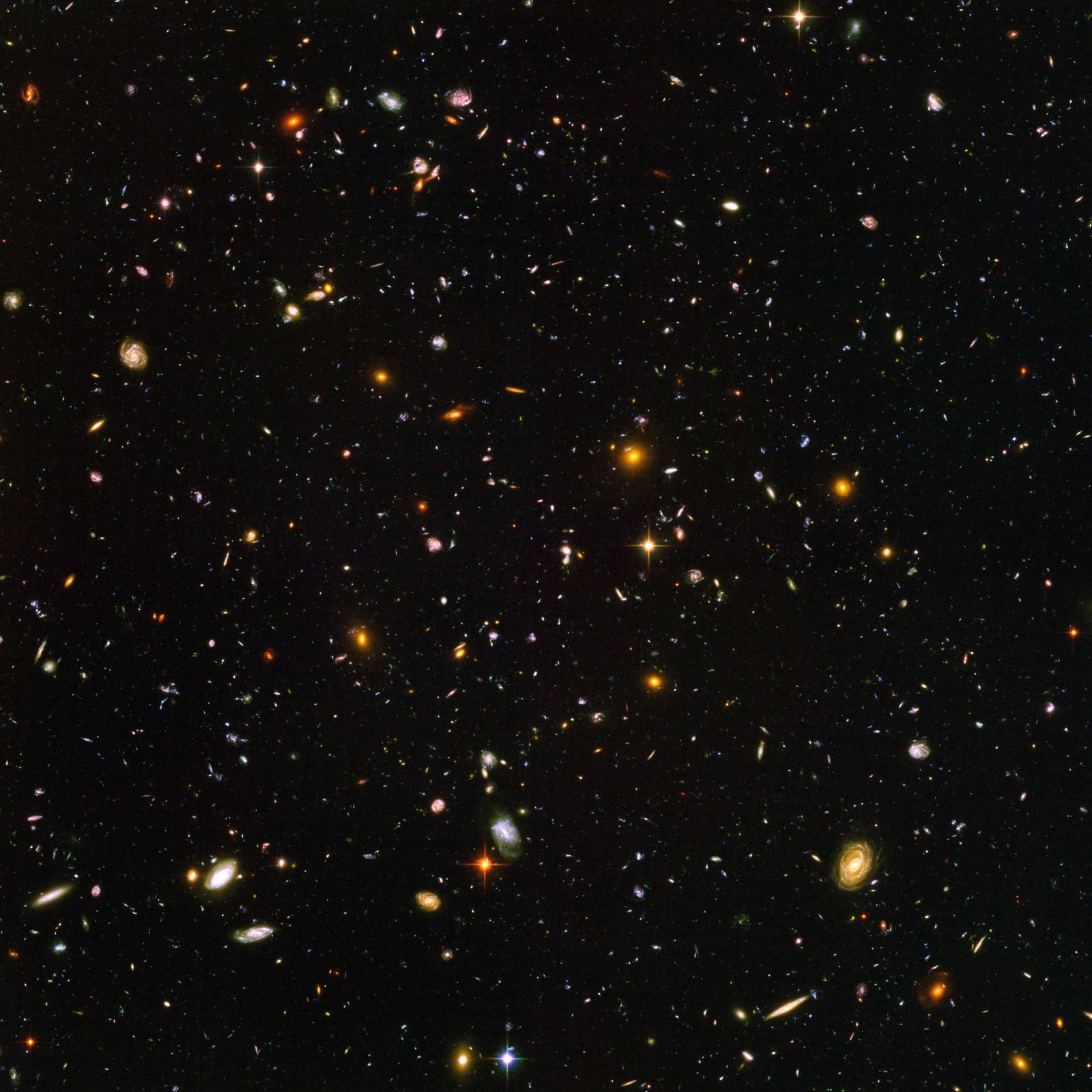
Plate 4 — Hubble Ultra Deep Field. About 10,000 galaxies in the constellation Fornax, in a million-second exposure built from 800 exposures across 400 orbits between 24 September 2003 and 16 January 2004, released on 9 March 2004. More than 500 of its galaxies date from less than a billion years after the Big Bang. The Advanced Camera for Surveys took the visible-light image; NICMOS supplied an infrared companion view.
Credit: NASA, ESA, and S. Beckwith (STScI) and the HUDF Team
The gamble was repeated and deepened. The Ultra Deep Field of 2004 used 400 orbits and a million-second exposure to find about 10,000 galaxies, more than 500 of them from within the universe's first billion years.
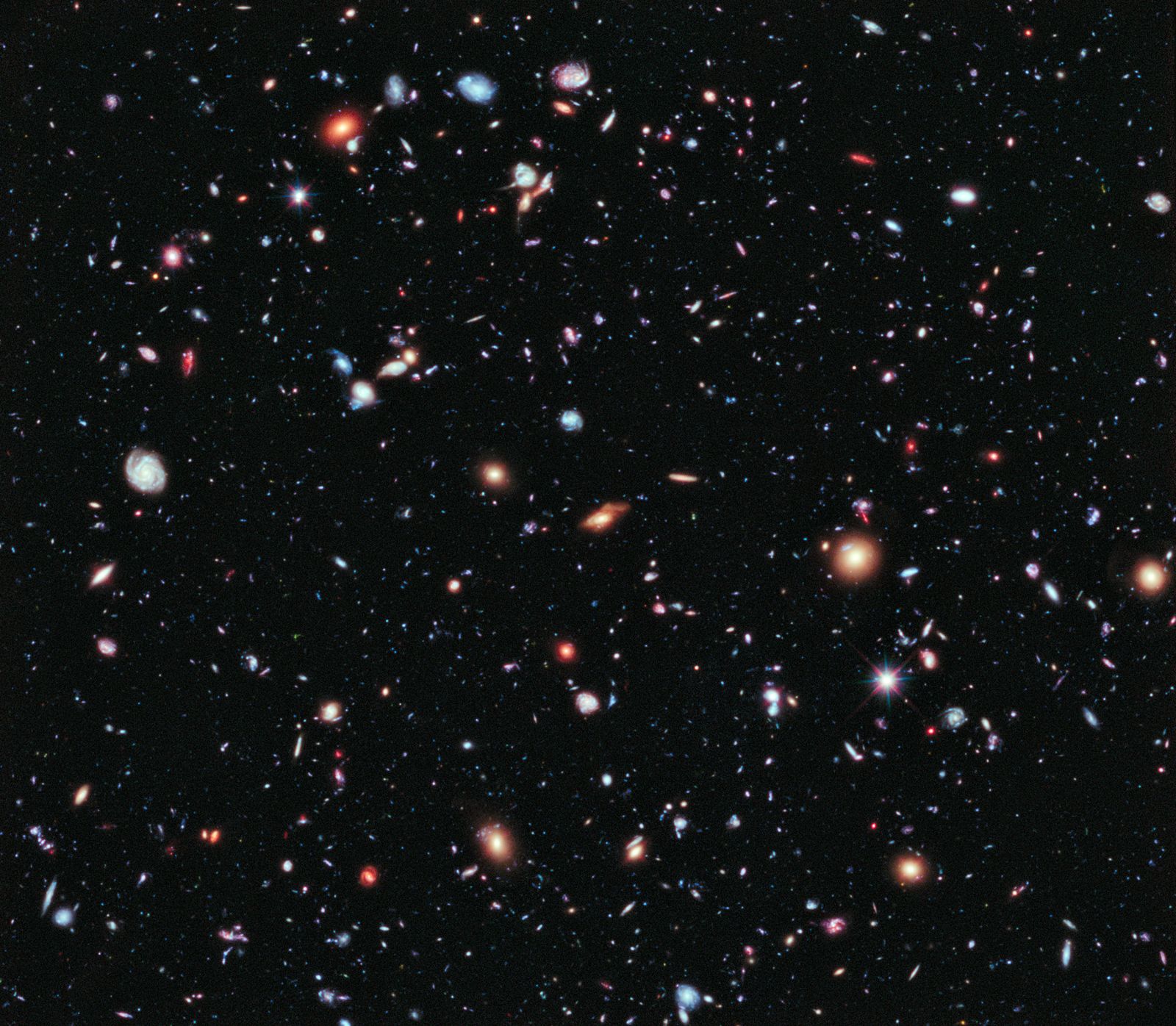
Plate 5 — Hubble eXtreme Deep Field. The deepest view Hubble has made: some 5,500 galaxies in the centre of the Ultra Deep Field, combining ten years of data and two million seconds of exposure between 2002 and 2012, released on 25 September 2012. Its faintest objects shine at one ten-billionth of the brightness the naked eye can detect. Advanced Camera for Surveys and Wide Field Camera 3 data.
Credit: NASA, ESA, G. Illingworth, D. Magee, and P. Oesch (University of California, Santa Cruz), R. Bouwens (Leiden University), and the HUDF09 Team
The eXtreme Deep Field of 2012 folded a decade of data — two million seconds — into the centre of that field, reaching some 5,500 galaxies and objects one ten-billionth as bright as the faintest the naked eye can see.
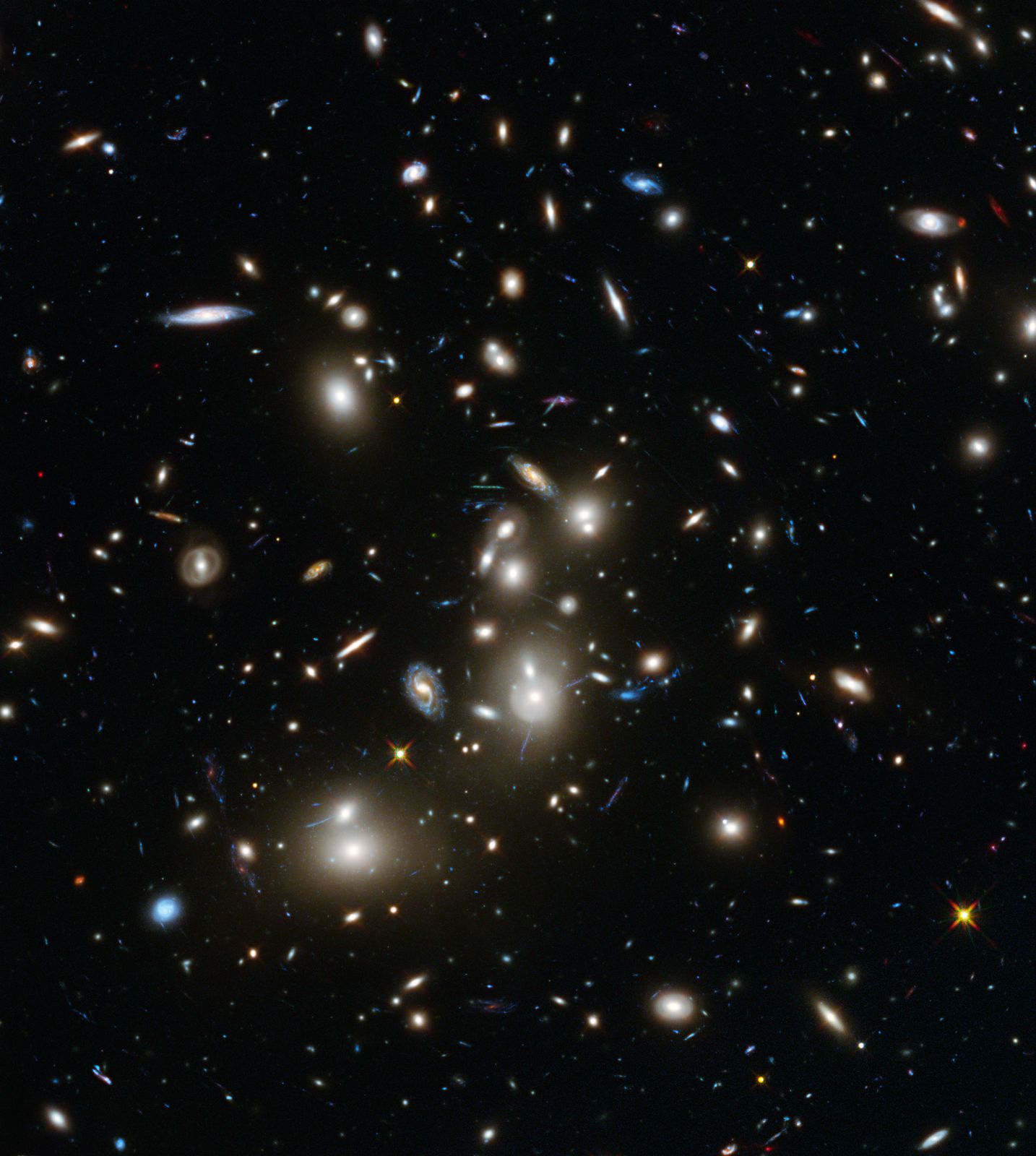
Plate 15 — Frontier Fields: Abell 2744, "Pandora's Cluster."** A pile-up of galaxy clusters whose combined gravity acts as a lens, magnifying about 3,000 background galaxies, some more than 12 billion light-years away. The first image of the Frontier Fields programme — six clusters, three years, 840 orbits, working with the Spitzer and Chandra observatories — released on 7 January 2014, from Advanced Camera for Surveys and Wide Field Camera 3 data. Credit: NASA, ESA, and J. Lotz, M. Mountain, A. Koekemoer, and the HFF Team (STScI) **Rights-flagged plate (not captioned; for the build). Plate 8, the Carina Nebula panorama, blends Hubble's ACS data with ground-based colour data from CTIO carrying third-party rights (NOAO/AURA/NSF). It is flagged in the research report for exact-rights verification before any use, and will be cleared or swapped at build; the clean Plate 9 (Mystic Mountain, WFC3) covers Carina in the meantime.
Credit: NASA, ESA, and J. Lotz, M. Mountain, A. Koekemoer, and the HFF Team (STScI)
The deep fields' logic extends through the Frontier Fields programme, which turned massive galaxy clusters into lenses: their gravity magnifies the still more distant galaxies behind them. Its first image, of the pile-up cluster Abell 2744 in 2014, showed about 3,000 background galaxies, some more than 12 billion light-years away. Lensing also delivered Earendel in 2022 — the most distant individual star ever seen, its light magnified thousands-fold by a foreground cluster, found not at the telescope but in archival data, in the RELICS survey's holdings. Hubble's archive, kept public at the Mikulski Archive for Space Telescopes, is itself an instrument: the millionth observation, in 2011, was spectroscopy hunting water in the atmosphere of the exoplanet HAT-P-7b, and discoveries continue to be mined from data years after it was taken.
Set the four deep images in sequence and they make the argument of this whole part in one spread: the same telescope, staring at nearly the same nothing, counting 3,000 galaxies, then 10,000, then going deeper, then — in the Legacy Field of 2019 — widening the frame to some 265,000 galaxies assembled from 7,500 exposures across sixteen years. The Legacy Field literally contains the eXtreme Deep Field inside it. As of 2026 the archive behind all this holds more than 477 terabytes, and astronomers still apply for Hubble's time at about six or seven proposals for every slot available. The findings in this chapter are usually described as Hubble's discoveries; the deeper description is that they are the compound interest on a repair.
Chapter 6 — The Elder
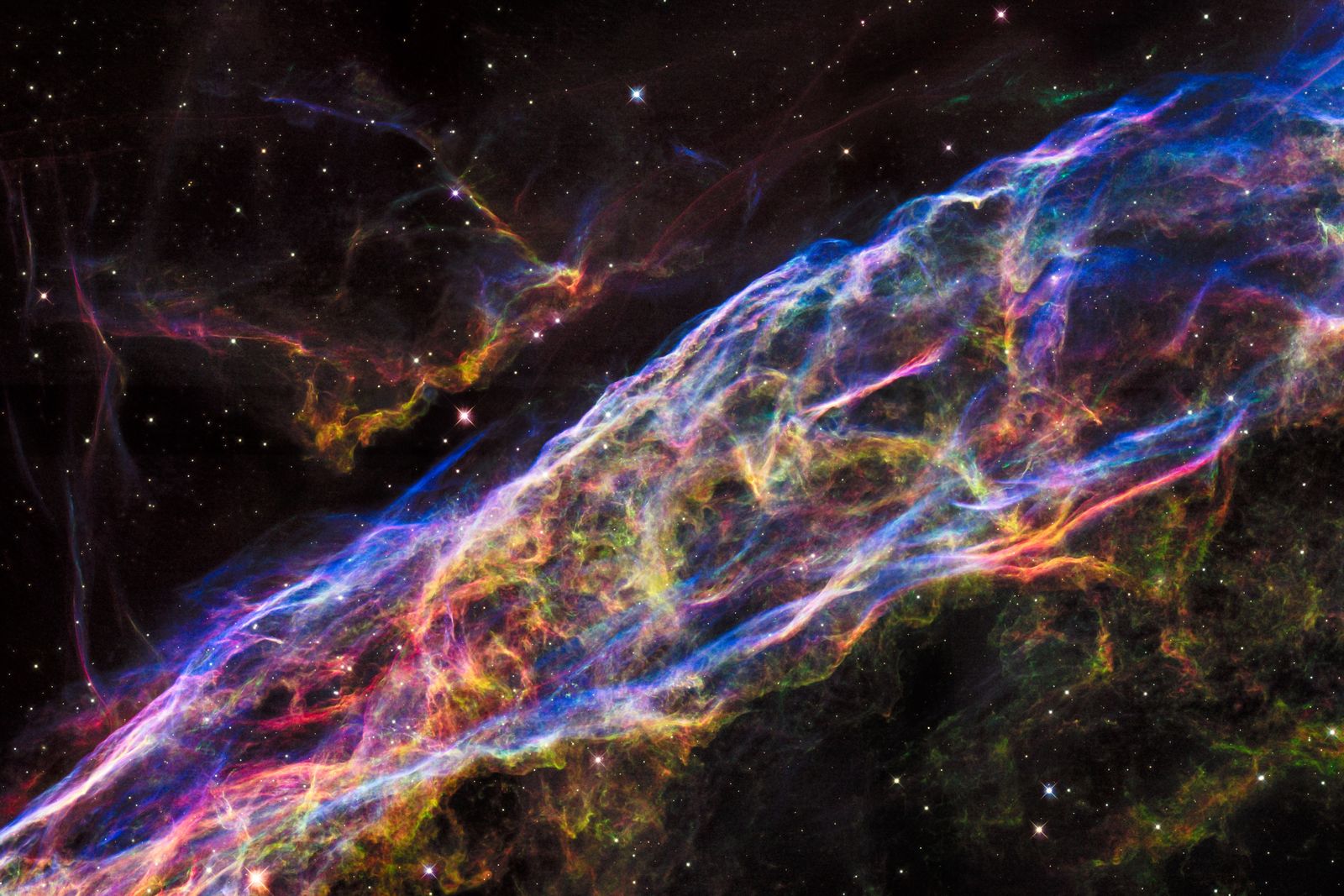
Plate 11 — Veil Nebula. Filamentary shrapnel of a star that exploded about 8,000 years ago: a six-frame mosaic, about two light-years across, of one sliver of the 110-light-year Cygnus Loop. The Wide Field Camera 3 took the frames on 14 to 17 April 2015; the image was released on 24 September 2015, and a reprocessed version followed in 2021.
Credit: NASA, ESA, Hubble Heritage Team
Since 2009, Hubble's story has been a long exercise in a particular engineering craft: trading capability for lifetime, on purpose, one subsystem at a time. The craft began earlier than the last servicing mission. In August 2005, with three gyroscopes working, Hubble deliberately shut one down and began two-gyro science operations — banking the idle gyro's remaining life against the day the others failed. It was the first formal admission that the telescope's senses would be rationed, and it worked: two-gyro mode ran until the final servicing mission refreshed the stock in 2009.
The failures since have been met the same way, from the ground, by people who cannot touch the machine. In October 2018 a gyro failure put Hubble in safe mode; the operations team diagnosed the misbehaving unit and had restored full science by 26 October 2018, working around the failed gyroscope rather than through it — an early rehearsal, though no one framed it that way at the time, for the one-gyro decision of 2024. In June 2021 the payload computer — the NSSC-1, hardware of 1980s design that coordinates the instruments — halted outright. For a month the telescope did nothing — safe mode, in the engineers' vocabulary: powered, stable, pointed safely, and scientifically silent — while engineers on the ground rehearsed the switch to backup hardware on a testbed, then executed it; full operations were restored by 17 July. That autumn the instruments lost their synchronisation messages and the observatory safed again; the team brought the cameras back one by one — ACS on 8 November, then COS and WFC3 — with all four active instruments restored by 6 December 2021, the fix delivered largely as instrument software changes rolled out from mid-December.
The largest rationing decision came on 4 June 2024. Of the six gyroscopes installed in 2009, three remained operational — but one of the three had spent six months returning faulty readings, claiming the telescope was slewing at maximum rate regardless of its actual motion, and repeatedly forcing safe modes, most recently on 24 May 2024. NASA's answer was to change how Hubble points: from then on it would operate on a single gyroscope, holding the second healthy gyro in reserve and monitoring the faulty third. Hubble was designed to do science on one gyro — the mode had been test-demonstrated back in 2008 with no loss of image quality — and science resumed in mid-June. The costs are real but bounded: longer slews and lock-on times, less of the sky accessible at any given moment, and no tracking of moving targets closer than Mars. Science-press estimates put the price at roughly 12 per cent less observing time and up to a quarter less scientific output; the gain is measured in years of the remaining gyroscopes' lives. NASA put the probability of at least one working gyro through 2035 at better than 70 per cent. The reserve arrangement matters to how that figure should be read: if the flying gyroscope fails, the answer is a switch to the healthy spare, not the end of the mission — the rationing is designed so that its own most likely failure is already provided for.
On 19 September 2026, Hubble completed its 200,000th orbit — more than 5 billion miles travelled — and NASA marked the occasion with the telescope at work, hunting a gravitationally lensed supernova in the cluster MACS J0417. A year and a half earlier it had passed its 35th anniversary in orbit with a set of new releases: Mars, planetary nebulae, the Rosette, the barred spiral NGC 5335. The standing totals at that anniversary describe the scale of the working life behind the rationing: nearly 1.7 million observations of some 55,000 targets, more than 22,000 papers in print, and an archive already past 400 terabytes and growing toward the 477 terabytes recorded as of 2026. The elder is not commemorating itself. It is observing.
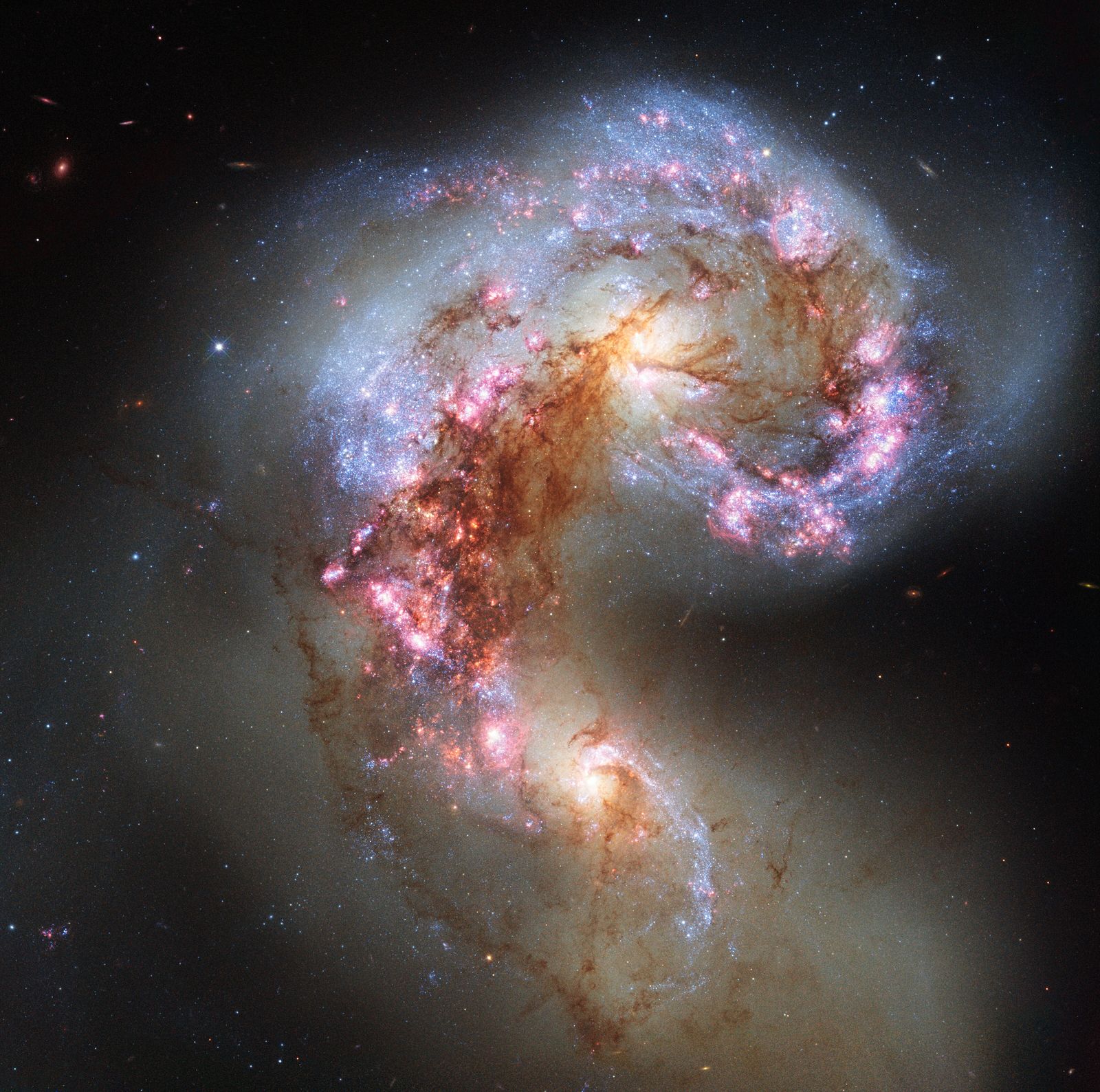
Plate 13 — Antennae Galaxies. Two colliding spiral galaxies, NGC 4038 and NGC 4039 — the nearest and youngest galaxy merger known — ablaze with newborn blue star clusters set in pink hydrogen gas. This best-ever version, combining Wide Field Camera 3 and Advanced Camera for Surveys data, was released on 11 November 2013; earlier versions date to 1997 and 2006.
Credit: ESA/Hubble & NASA
What keeps it indispensable is a band of light. Hubble works from about 0.1 to 2.5 micrometres — ultraviolet, visible, near-infrared. The Webb telescope, for all its power, sees no ultraviolet at all: its range begins at 0.6 micrometres, in the infrared. Roman, as Part Two will show, has no ultraviolet either. And no ground telescope can substitute, because Earth's atmosphere blocks most ultraviolet light before it arrives. The hottest and most energetic phenomena in the sky announce themselves in UV: massive young stars, gas spiralling toward black holes, supernova shock fronts, the warm gas between and around galaxies that the Cosmic Origins Spectrograph reads in the light of background quasars, aurorae and weather on the giant planets, and the upper atmospheres of exoplanets, where escaping hydrogen is visible precisely in ultraviolet. COS itself is the sharpest expression of the niche: an ultraviolet-only spectrograph, at least ten times as sensitive as Hubble's previous ultraviolet instruments and up to seventy times so for the faintest objects. Hubble's ultraviolet sharpness and sensitivity remain, in the words of one astronomer quoted by Science News, the best thing the species has ever done at those wavelengths. No successor with comparable ultraviolet capability is expected before the proposed Habitable Worlds Observatory, a 2040s mission. When Hubble stops, it will leave a gap of a decade or more in a whole colour of light.
The working kit that carries this programme, as of late 2026, is four instruments and a guidance system that doubles as a fifth: WFC3, the main imager, working from ultraviolet through near-infrared; ACS, the survey camera, repaired in 2009; COS in the ultraviolet; STIS, the general-purpose spectrograph, likewise revived; and the three fine guidance sensors, which hold the telescope's pointing and, between pointings, do precision astrometry of their own — measuring stellar distances and the orbits of binary stars with an accuracy no other flying instrument matches, a second scientific career hidden inside a pointing device. Mission operations run from Goddard; science operations from the institute in Baltimore. There will be no further astronaut visits — the shuttle fleet retired in 2011, and no servicing mission is scheduled or, with current vehicles, possible. Everything in the preceding paragraphs was achieved under that condition: a telescope beyond reach, kept at the frontier by software, procedure, and patience.
The emblem of late-life Hubble arrived on 5 January 2026, and it is a discovery made of an absence. Radio telescopes — FAST in China and the Very Large Array — had found a cloud of hydrogen near the galaxy M94, about 14 million light-years away: gas-rich, dark-matter-dominated, and, on the radio evidence, containing no stars at all. The object, named Cloud-9, would be the first confirmed example of a predicted class, a Reionization-Limited H I Cloud — a relic of early galaxy formation that never lit up. Confirming it required proving a negative, and that was Hubble's job: its Advanced Camera for Surveys searched the cloud and found the absence of stars the theory required. Cloud-9 stands as the first confirmed RELHIC: a galaxy that failed to happen, identified in Hubble's thirty-sixth year by the steadiness of its gaze. It is hard to think of another observatory whose headline result of the year was a measurement of nothing, made precisely enough to settle a question theory had left open.
That is the elder statesman's actual situation in late 2026: rationed, repaired by radio, still first in line for the hardest light there is — and still discovering things no one else can see.
Chapter 7 — The Open Ending
Hubble cannot save itself. It has no propulsion: no engine, no thrusters with which to raise or even maintain its orbit. Every metre of altitude it has ever gained after deployment was given to it by a visiting shuttle, and the last of those gifts came in 2002. Since then, the faint drag of the upper atmosphere has been pulling it down, orbit by orbit, year by year. Deployed at roughly 570 kilometres, it is now below 500 km and falling (late 2026), circling the Earth about every 95 minutes. NASA's current analysis, published in October 2026, predicts that Hubble is likely to re-enter the atmosphere in the 2033 to 2034 timeframe. A lifetime analysis from July 2026, quoted from the text of NASA's request for information, sharpens the shape of that forecast: a 10 per cent probability of re-entry by September 2032, and 50 per cent by December 2033. The Space Telescope Science Institute's own median forecast is the same: mid-2033.
The strange part is what will end the mission. It will not be the instruments. Hubble's hardware has repeatedly outlasted the estimates made for it, and the institute's 2025 assessment put the probability that at least two fine guidance sensors, one gyroscope, and three reaction wheels would still be working in 2030 above 90 per cent — with less than a 10 per cent chance of re-entry before 2030 on the same forecasting. Older forecasts of operations "into the 2030s" or "until 2030–2040" were statements about hardware, and on the hardware they may well prove right. In 2026 the binding constraint flipped: the telescope will probably outlive its orbit. The mirror is fine. The sky is fine. The altitude is not.
An uncontrolled end is not a tidy one. Hubble was never designed for controlled disposal, and a 2022 re-entry casualty study, cited in 2026 reporting, estimated that around 20 per cent of its mass — some 2.6 tonnes — could survive re-entry to the surface, with a casualty probability of roughly 1 in 330, against NASA's standard of 1 in 10,000 for uncontrolled re-entries. Those are reported study figures rather than NASA-confirmed numbers, but they explain why any serious conversation about Hubble's future now includes the end as one of its subjects. This risk arithmetic, as much as the science case, is why a controlled re-entry or disposal option stands as one of the three tracks in NASA's 2026 request. (One outlier analysis, by the astronomer Jonathan McDowell, allows re-entry as early as 2028 under high-drag assumptions — well outside the NASA and institute distribution, and noted here only so the reader knows the range of published argument.)
The rescue question has its own four-year history, and it runs in a circle. In 2022 NASA and SpaceX signed an unfunded Space Act Agreement to study boosting Hubble with a Crew Dragon — an idea that came from Jared Isaacman's Polaris Program and was offered at no cost to the government. NASA also sought other commercial concepts, and in 2023 a robotic servicing concept from Astroscale and Momentus was publicly offered. Then, on 4 June 2024 — the same day it announced one-gyro operations — NASA declined to pursue a reboost: having explored current commercial capabilities, in Astrophysics director Mark Clampin's words, "we are not going to pursue a reboost." Reporting of the decision cited substance behind the caution, including the risk that a visiting vehicle's outgassing could contaminate Hubble's ultraviolet-sensitive optics, and the fact that the capture procedure had never been demonstrated.
The circle turned again. Isaacman, the reboost's original proposer, was confirmed as NASA Administrator in December 2025. By June 2026, agency officials — Shawn Domagal-Goldman, speaking to an advisory committee — were saying publicly that reboost costs looked lower than expected and that NASA was, after all, "open to a reboost." Read in sequence, the positions describe an agency arguing with itself in public across four years: a study welcomed in 2022, a door closed in 2024, the same door reopened in 2026 by a leadership that now included the man who had first proposed walking through it. Fresh in everyone's mind, though, is a cautionary precedent from the same season: NASA's commercial boost attempt for the Swift observatory, using Katalyst's LINK vehicle, concluded in September 2026 without raising Swift's orbit. Swift ended its science on 20 October 2026 and was expected to re-enter in early November. Whoever bids to save Hubble now does so in that attempt's shadow.
Which brings the story to its live edge. On 29 October 2026 NASA issued a formal request for information, notice 80GSFC27RFIHSTS, asking industry for its capability across three tracks: boost Hubble to a higher orbit — the notice's text targets at least 600 kilometres — service it to improve its capability or resilience, or dispose of it by controlled re-entry. The three tracks are genuinely different futures. A boost is the minimal intervention: it buys altitude and nothing else, and if secondary analyses are right, a successful lift to 600 kilometres or above could add decades of orbital lifetime, after which the instruments, not the orbit, would set the end. Servicing is the ambitious version: new gyroscopes or batteries, perhaps more, delivered by a vehicle that would have to rendezvous with a telescope never designed for robotic visitors — though the 2009 crew did leave it a soft-capture ring, a docking target fitted precisely so that a future vehicle would have something to hold. Disposal is the sober version: accept the end, and spend the money making it a safe one. NASA is explicit about what this is and is not: an information-gathering exercise only. No provider has been selected, no contract offered, no budget announced. Responses are due at 3 p.m. Eastern on 30 November 2026 — days after this book's snapshot date, and barely a month after the request was issued, a timetable that itself says something about how NASA reads the decay curve. Any mission that results would need to fly by 2032, ahead of the predicted re-entry. Isaacman's framing, in the announcement, was plain: "Hubble still has important science ahead of it… If there are innovative and cost-effective ways to extend the life of an asset already on orbit, we owe it to the American taxpayer and the scientific community to explore them." Associate administrator Nicky Fox added the timing logic: explore a boost now, while the flagship meant to follow Hubble's ultraviolet line — the Habitable Worlds Observatory — is still in development.
Part One therefore ends the way the telescope's own story currently stands: unfinished, on a deadline. As of November 2026, Hubble is observing on one gyroscope, below 500 kilometres, with its discoverers still queueing for its time — and the question of whether anyone will come for it one more time is open, dated, and awaiting answers by 30 November. As of this book's snapshot, no company had publicly declared a response to the request; the first hard fact in the next chapter of this story will be the response list itself, and what it reveals about whether the commercial space industry believes a 36-year-old telescope is a business case, a responsibility, or both. The telescope, meanwhile, does what it has done through every previous uncertainty in its long life — the flaw, the cancellations, the failures, the rationing. It observes, on schedule, tonight.